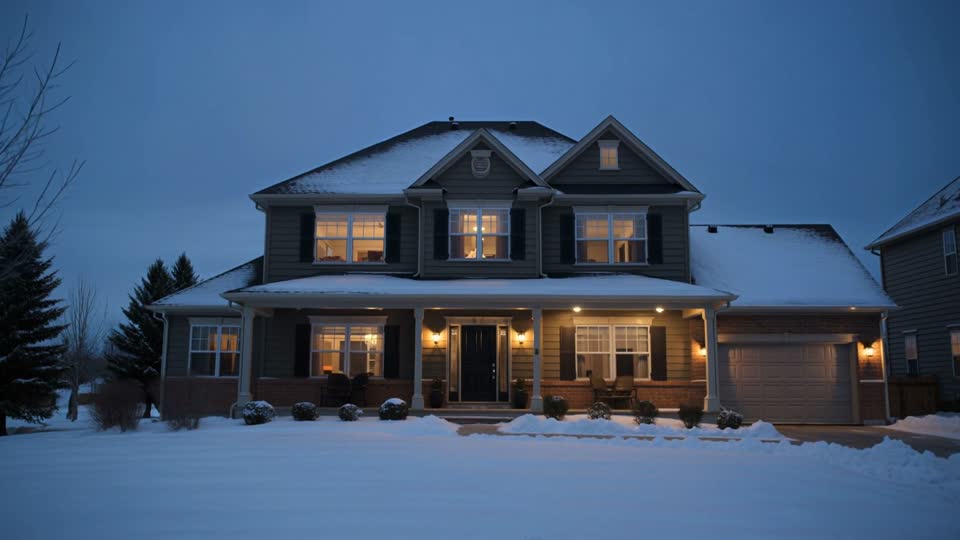
Guide · Drawing E-410
Smoke and carbon monoxide alarms
Smoke and CO alarms are small, inexpensive devices that do the most important job in a house. This guide covers what Alberta’s building and electrical codes ask for, how the wiring works, and what the Calgary Fire Department recommends for every home.
Two sets of rules meet at a smoke alarm. The National Building Code (Alberta Edition) decides where alarms go and that they work together. The Canadian Electrical Code decides how they are powered. The Calgary Fire Department adds advice that goes further than the minimum for existing homes. Each is covered below.
CCT 01What the building code requires
The National Building Code (Alberta Edition), NBC(AE), sets where smoke alarms go in a dwelling unit, and where a residence has more than one smoke alarm it requires them to be interconnected 1. Alberta's STANDATA bulletin on Section 32 of the 2024 electrical code summarizes the location rules as covering each floor level, all sleeping rooms and basements 1.
Interconnection is the point. When one alarm senses smoke, every alarm sounds, so a fire in the basement wakes someone asleep on the top floor.
These requirements apply in full to new homes and to work that is permitted now. An installation that met the code when it was built generally does not have to be brought up to a newer edition, although modifications can trigger current-code compliance 2. A basement development, a secondary suite or a major renovation is the usual trigger for upgrading an older Calgary home to hard-wired, interconnected alarms.
Secondary suites are spelled out plainly. The City's suite requirements call for smoke and CO alarms at or near the ceiling of each floor level in both the main home and the suite, in each bedroom, common space and supplementary space such as the furnace room. They must be permanently wired and interconnected so that one alarm sounds every alarm in the suite and at least one in the main residence 3. See basement and renovation wiring.
CCT 02The circuit behind a hard-wired alarm
Regular residential smoke alarms normally need a 120 V connection from a 15 A circuit 1. The STANDATA bulletin adds that the conductors must be copper with enough ampacity for the circuit, which means No. 14 AWG or larger 1.
The City's homeowner wiring guide adds Calgary practice:
- Smoke and CO alarms go on a hard-wired 120 V circuit that also serves at least one light. If the breaker is off, the dark room tells you.
- They must not be on a circuit protected by an arc-fault or ground-fault interrupter unless each alarm has an integral backup battery. The GFCI and AFCI guide explains why.
- Only a building safety codes officer can decide acceptable locations.
Source: the City guide 4. The guide is labelled as including 2021 code amendments, one edition behind the code now in force, so an electrician confirms these points against the 2024 edition.
Interconnection itself can be a third conductor in the cable between alarms, or, where the alarm circuit is supplied from a Class 2 power supply in a combustible building, an approved Class 2 wiring method. The bulletin warns that extra-low-voltage cable such as Type LVT must not enter boxes holding higher-voltage conductors 1.
CCT 03Calgary Fire Department guidance for every home
For existing homes, the Calgary Fire Department's advice is the practical standard. It recommends at least one smoke alarm on every level of the home, including the basement, and one inside every bedroom or outside every sleeping area 5. Test alarms monthly and replace them after ten years 5.
- Sensor type. The CFD notes ionization alarms suit fast-flaming fires and photoelectric alarms suit slow, smouldering ones. It suggests both types, or dual-sensor alarms, for the best protection.
- Listing. Look for a ULC marking.
- Battery backup. Hard-wired alarms should have battery backup for power outages.
- Age. The manufacture date is on the back. If it is ten or more years old, or missing, replace the alarm.
Source: CFD 5. The reason to take this seriously has changed, too. Calgary saw an estimated $32 million or more in property losses from lithium-ion battery fires in 2025 6. Those batteries are often charged in basements and garages, one more reason to make sure the basement alarm works.
CCT 04Carbon monoxide alarms
Carbon monoxide has no colour, smell or taste. The CFD says the furnace is most commonly the main source of CO in a home, alongside any appliance burning natural gas or propane 7. Its advice:
- At least one CO alarm on every level, including the basement. The most important location is in or near bedrooms.
- Test monthly. CO alarms expire, typically after 5 to 10 years depending on the manufacturer, and hard-wired units need replacing when they expire.
- Look for a ULC or cUL marking.
On the code side, Alberta Municipal Affairs' 2017 safety tip, now archived, said the Alberta Building Code requires CO alarms in every new building that contains a residential occupancy and a fuel-burning appliance or an attached storage garage, and recommended them for existing homes 8. Treat that as a summary of the rule's intent; an electrician or the City confirms the current NBC(AE) wording for a specific project.
Smoke and CO alarms can be linked. The STANDATA bulletin says the electrical code does not address it directly but allows it when each device is approved, the devices are suitable for interconnection with each other according to the manufacturers, and each is installed to Rule 32-200 and the instructions 1. Combination smoke and CO units are also acceptable in suites 3.
CCT 05Permits and who does the work
In Calgary an electrical permit is required for new wiring and for extending or altering branch circuits 9. Adding alarm locations, running interconnect cable or adding a circuit falls under that. The City does not require a permit when only fixtures are replaced 9; if you plan to swap existing hard-wired alarms for new ones, confirm with the City whether your swap counts.
Homeowners who live in the home can take out a homeowner permit for this kind of work, at $116.50 10. The home must not be a rental 9. A basement development needs its own electrical permit 11. The homeowner permit guide explains the conditions.
Safety
Electrical work in Alberta needs a permit, most of it needs a certified electrician, and homeowner permits have limits. Swapping a hard-wired alarm means working in a live ceiling box unless the right breaker is off and verified dead. Never work on energized equipment, and never leave an alarm disconnected to stop a nuisance alarm. If an alarm will not stop sounding and you smell smoke or feel CO symptoms, leave the house and call 911.
For a new home, see new and custom home wiring. The electrical share of a basement, including alarms, is covered in basement electrical cost.
CCT 06Chirping and false alarms on hard-wired systems
Hard-wired alarms that chirp or sound for no reason are a common complaint. Most causes are simple, and none of them justify disconnecting an alarm.
- A single chirp every minute or so usually means the backup battery is low, or the alarm has reached end of life. Some units chirp at the end of their rated life even with a good battery. Check the date on the back.
- All alarms sounding at once is interconnection doing its job. One unit started it. Some models have an indicator that shows which alarm initiated.
- Alarms near kitchens and bathrooms. The CFD says nuisance alarms can come from dust or from smoke and steam near kitchen appliances. It suggests cleaning, relocating the alarm away from kitchens and bathrooms, or a model with a hush feature 5.
- A breaker that trips. Alarms should not normally share an arc-fault or ground-fault protected circuit without integral battery backup, as above. A tripping alarm circuit needs an electrician; see inspections and troubleshooting and a breaker that keeps tripping.
Alarms generally interconnect only with models the manufacturer lists as compatible, which is why the STANDATA bulletin points to the manufacturers' literature. When replacing one alarm in an interconnected set, match the brand and series or replace the set. To have alarms added, relocated or a suite brought up to standard, request a quote and a person replies.
Questions people ask
Are carbon monoxide detectors mandatory in Alberta?
For new homes with a fuel-burning appliance or an attached garage, the building code has required CO alarms, according to Alberta Municipal Affairs' archived 2017 safety guidance 8. Calgary's secondary suite requirements list CO alarms in each bedroom, common space and furnace room. For other existing homes, the Calgary Fire Department recommends a CO alarm on every level.
Do smoke alarms have to be hard-wired in Alberta?
In new construction and permitted renovations, the codes expect permanently connected, interconnected alarms; Calgary's suite requirements say so directly 3. Older homes generally do not have to be upgraded unless work triggers it. Battery alarms are still far better than none in an older house.
How often should hard-wired smoke detectors be replaced?
The Calgary Fire Department says to replace smoke alarms after ten years, whether they are battery-powered or hard-wired 5. CO alarms have their own lifespan set by the manufacturer. Check the date on the back of each unit.
Why do my hard-wired smoke detectors go off for no reason?
Common causes are dust, steam or cooking smoke near the alarm, an alarm at the end of its life, or one unit in an interconnected set triggering all of them. Clean the units, check their dates and find which alarm initiated. If a circuit trips or alarms keep sounding, have an electrician check it.
Can I replace a hard-wired smoke alarm myself?
Only with the breaker off and verified, and only with a compatible model. Adding new alarm locations or new cable is new wiring that needs a permit, and a homeowner permit is limited to owner-occupied homes where the owner does the work. When in doubt, have an electrician do it.
Sources
- STANDATA bulletin 24-ECB-032 Fire alarm systems, smoke alarms, carbon monoxide alarms, and fire pumpsAlberta Municipal Affairs · April 2025
- STANDATA bulletin 24-ECB-000 Object, scope, and definitionsAlberta Municipal Affairs · April 2025
- Secondary Suite Incentive Program: safety element detailsThe City of Calgary · retrieved 2026-09-25
- Homeowners electrical wiring guide (labelled as including 2021 CE Code amendments)The City of Calgary · copyright 2024
- Smoke alarmsCity of Calgary (Calgary Fire Department) · retrieved 2026-09-25
- Fire Prevention WeekCity of Calgary (Calgary Fire Department) · retrieved 2026-09-25
- Carbon monoxide alarmsThe City of Calgary (Calgary Fire Department) · retrieved 2026-09-25
- Safety Tips: Carbon Monoxide Home Installation (archived)Alberta Municipal Affairs · May 2017
- Homeowner electrical and plumbing permitsCity of Calgary · retrieved 2026-09-25
- 2026 Building & Trade Permit Fee Schedule (R2026-02)The City of Calgary · 2026 fee schedule, revision R2026-02; retrieved 2026-09-25
- Home renovations and basementsCity of Calgary · retrieved 2026-09-25
Related
-
 E-401
Electrical permits in Calgary
When you need an electrical permit in Calgary, homeowner versus contractor permits, inspections and what happens without one.
E-401
Electrical permits in Calgary
When you need an electrical permit in Calgary, homeowner versus contractor permits, inspections and what happens without one.
-
E-402
Hiring an electrician
Certification, master electricians, permits, insurance, quotes and contracts: what to check before anyone opens your panel.
-
 E-403
The electrical code in Alberta
Which edition of the Canadian Electrical Code applies in Alberta, how Alberta amends it, and where STANDATA bulletins fit.
E-403
The electrical code in Alberta
Which edition of the Canadian Electrical Code applies in Alberta, how Alberta amends it, and where STANDATA bulletins fit.