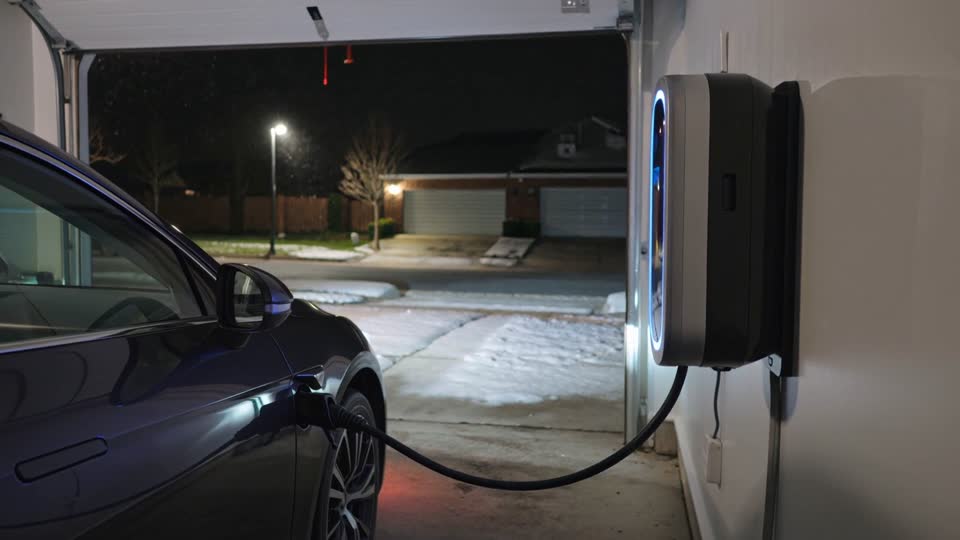
Residential · Drawing E-102
Home EV charger installation in Calgary
A Level 2 charger is a large load that runs for hours on its own circuit. How simple the job is depends on your service capacity, the distance from the panel to the parking spot, and who owns the electrical system.
Electric vehicles are still a small share of Alberta's fleet: 20,563 battery-electric vehicles were registered in the province in 2025,17 about 0.54% of registered road motor vehicles.17 That matters for homeowners because many Calgary houses were not wired with a charger in mind. On a good day the installation is a single circuit. Otherwise it becomes a load-management or service-upgrade project. The difference is settled at the panel before anyone buys a charger.
CCT 01What a Level 2 installation involves
Level 1 charging uses an ordinary receptacle and the cord that came with the car. It is slow, but for a short commute it can be enough. Level 2 needs a dedicated two-pole circuit from the panel, the same kind of circuit that feeds a range or dryer, ending at a hardwired charger or at a receptacle the charger plugs into. Before you decide, the EV charging at home guide compares the two and the EV charging time calculator shows how many hours each would take for your driving.
What an electrician needs to know at the first visit:
- The charger's spec sheet: its maximum current, whether that can be adjusted, and how (a DIP switch or setting only an installer can change, or an app setting you can change).
- Hardwired or plug-in. Hardwiring avoids a receptacle connection carrying a heavy load for hours. A plug-in unit is easier to replace. Follow the charger maker's instructions and warranty terms.
- The route: panel location, parking spot, finished or unfinished walls and ceilings, and whether the garage is attached or detached.
- What else is coming: a heat pump, air conditioning, a hot tub or a second EV. Plan the capacity once rather than twice.
CCT 02Can your panel carry a charger?
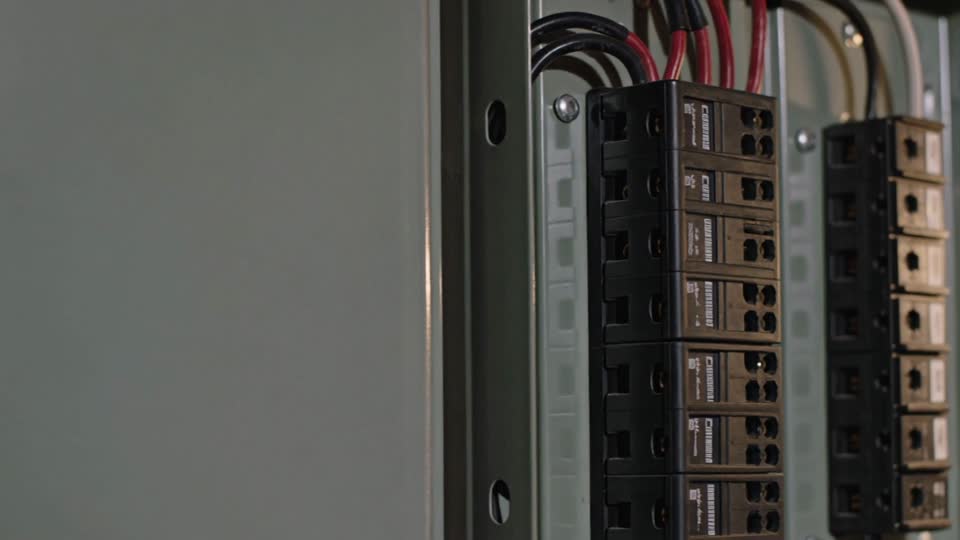
A spare space in the panel does not mean spare capacity. Capacity comes from the load calculation that Rule 8-200 of the Canadian Electrical Code sets for a single dwelling. Loads over 1,500 W go in at their nameplate rating.1 If the charger's current setting can be changed without an electrician, it has to be counted at its maximum demand.2 So a charger turned down in an app still counts as a full-size load.
From the result, a contractor has three routes:
- It fits. The existing service has room once the charger is counted, and the job is a new circuit.
- Load management. An EV energy management system (EVEMS) watches the home's load and cuts back or pauses the charger when other large loads run, so the charger can share an existing service. Calgary does not let homeowners install an EVEMS or load management system under a homeowner permit.3
- A bigger service. If the numbers do not work, the charger becomes part of a panel and service upgrade, with ENMAX involved. If you also expect a heat pump, note that NRCan says a 200 A service is normally required for an all-electric one.4
Try the home load calculator with the charger in and out to see where you stand before the site visit.
CCT 03The permit, and who can do the work
In Calgary an EV charger needs an electrical permit.5 Homeowner permits do not cover EV charging wiring, so the job goes on a contractor trade permit.3 The 2026 fee is a $112 processing fee6 plus $9.79 per $1,000 of construction value6 plus a 4% Safety Codes Council levy,6 with a minimum total of $116.50.6 Construction value includes materials you supply yourself, so a charger you bought counts toward it.6 Start before the permit is issued and the fee is charged twice (2×).6
Only a master electrician's contracting business can pull the permit in Alberta.7 Electrician is a compulsory certification trade, so the wiring is done by a certified journeyperson or a registered apprentice under one.8 Installations permitted on or after April 1, 2025 must meet the 2024 Canadian Electrical Code.9 The hiring guide shows how to check certificates.
Housing type changes the process:
- Rowhouses on a shared (gang) meter base need a Row Housing Electrification Authorization form signed by the condo board or homeowner association with the permit application.5
- Apartment-style condos are not eligible for homeowner permits at all.3 Parkade charging is a building project. When no EVEMS is used, EV equipment is counted at 100% when individual suite feeders in apartment-type buildings are calculated.1 See multi-unit EV charging.
- Outside city limits, Airdrie, Cochrane, Chestermere, Okotoks and Rocky View County issue their own permits.
Safety
Electrical work in Alberta needs a permit, and most of it needs a certified electrician. Calgary's homeowner permits do not cover EV charger wiring or load management, and they have other limits too. A charger circuit carries a heavy load for hours, so a loose connection or an undersized conductor causes heat, not just a tripped breaker. Never open a panel or work on energized equipment.
CCT 04The sequence, from site visit to first charge
- Site visit and load calculation. The electrician confirms capacity and chooses a route: a new circuit, load management or a service upgrade.
- Permit. The contractor applies before any work starts.
- Circuit installation. Cable or conduit from the panel to the charger location, a new breaker, and the charger mounted clear of the vehicle's path.
- Setting the current. On adjustable chargers the electrician sets the maximum current to match the circuit and the load calculation, and records it.
- Inspection. The City inspects under the permit. Where walls or ceilings are opened, the work may need a rough-in inspection before they are closed.
- Commissioning. A test charge, and a check that any load management responds as designed.
A detached garage adds a feeder and usually a small subpanel, a trench, and more inspection. Homeowners are asked to request locates at least three full working days before digging.10 Customer-owned lines, such as an existing house-to-garage feed, are not registered with Utility Safety Partners and need a private locator.10 See click before you dig and garages and subpanels.
Inspections do fail. In 2025, 15.6% of Calgary electrical inspections with a pass or fail result were marked "Not Acceptable".11 The City's dataset has no scope field, so it cannot show how many permits were for EV chargers.
CCT 05Calgary winters and where the charger goes
Calgary's January 2.5% design temperature is -30 °C,12 and the city has 5,000 heating degree-days a year.12 Winter shapes the installation in practical ways:
- Charge inside if you can. A garage keeps the connector free of ice and the cable flexible. If the charger goes outside, its enclosure rating and listed operating temperature matter, and so does a spot where snow clearing will not hit it.
- Cold cables stiffen. Mount the charger so the cable reaches the car's port without tight bends, whichever way you park.
- Batteries use energy to warm up. Many owners schedule charging or preconditioning before they leave, which puts heavy use on the circuit on the coldest mornings. Size the circuit for that, not for the average day.
- Block heater and garage heater circuits are separate loads, and they belong in the same load calculation.
The winter electrical guide covers outdoor receptacles, heat trace and cold-snap loads.
CCT 06What drives the cost
No official source publishes a price for a home Level 2 installation. NRCan lists the cost factors (the unit, labour and electrical work), notes that some provinces rebate up to 50% of installation, and gives no dollar range.13 Calgary's ChargeYYC charger rebate was for multi-residential buildings, capped at $1,000 for a single-port station,14 and its intake closed on November 18, 2025.14 It was never a detached-house rebate.
The quote depends on:
- Charger hardware, and whether you or the contractor supply it.
- Distance and route from the panel to the parking spot, and how much finished drywall is in the way.
- Panel capacity and space: a straight circuit, an EVEMS, or a service upgrade with ENMAX.
- Detached garage work: feeder, trench, locates and a subpanel.
- Permit at the job-value rate, and any repairs to finishes.
The EV charger installation cost guide goes through each driver.
CCT 07What home charging costs to run
Running cost is the energy you put in multiplied by your all-in price per kWh. ENMAX's Rate of Last Resort energy charge is 12.06 ¢/kWh, fixed to December 31, 2026, but it excludes delivery and administration charges,15 and many households are on a retailer contract at a different rate. Use the total cost per kWh from your own bill in the running cost calculator. Charging overnight in a garage also cuts the cold-weather losses you get parked outside.
When you request a quote, include a photo of the panel with its door open (not the cover off), the main breaker rating, the charger model if you have one, and the distance from the panel to where you park.
Questions people ask
Do I need a permit to install an EV charger in Calgary?
Can a normal electrician install an EV charger?
The permit rules for a charger are the same as for other wiring. The permit has to come from a contractor with a master electrician's certificate,7 and the work is done by a certified journeyperson or a supervised registered apprentice. Some charger makers set their own installation conditions for the warranty, so check the manual.
Do you need 200 amp service for an EV charger?
Not necessarily. The load calculation decides. Some homes on a 100 A service can add a charger as it is, and others can with an EVEMS sharing capacity. A 200 A service helps most when a heat pump or other large loads are also planned. Chargers that the owner can adjust are counted at their maximum.2
How much does it cost to install a Level 2 charger at home in Calgary?
There is no official figure. NRCan lists cost factors and mentions provincial rebates of up to 50% of installation, but publishes no home installation range.13 The published part is the City permit, from $116.50 upward on job value.6 The rest depends on the charger, the distance, panel capacity and whether a service upgrade is needed.
Is there an EV charger rebate in Calgary or Alberta?
The City's ChargeYYC rebates were for multi-residential buildings, not detached houses, and the intake closed on November 18, 2025. The City says it anticipates reopening.14 NRCan points to rebates of up to 50% of installation cost in some provinces.13 Check current programs before you count on one.
Sources
- STANDATA bulletin 24-ECB-008 Circuit loading and demand factorsAlberta Municipal Affairs · April 2025
- STANDATA interpretation 24-ECI-086 Electric vehicle charging systemsAlberta Municipal Affairs · April 2025
- Homeowner electrical and plumbing permitsCity of Calgary · retrieved 2026-09-25
- Heating and cooling with a heat pumpNatural Resources Canada · Page modified 2025-12-24
- Electrical permits for contractorsCity of Calgary · retrieved 2026-09-25
- 2026 Building & Trade Permit Fee Schedule (R2026-02)The City of Calgary · 2026 fee schedule, revision R2026-02; retrieved 2026-09-25
- About Master ElectriciansSafety Codes Council · retrieved 2026-09-25
- Compulsory Certification TradesGovernment of Alberta (Tradesecrets) · retrieved 2026-09-25
- Notice: New Canadian Electrical Code, Part 1 (April 2025)Alberta Municipal Affairs · April 2025
- Homeowner OverviewUtility Safety Partners · retrieved 2026-09-25
- Electrical Permits and Inspections (dataset vxgy-id5s)The City of Calgary, Open Government Licence – City of Calgary · queried 2026-09-25
- National Building Code - 2023 Alberta Edition, Volume 1, Division B, Appendix C, Table C-2 Climatic Design Data for Selected Locations in AlbertaAlberta Municipal Affairs / National Research Council of Canada · 2023 Alberta Edition, second printing incl. revisions and errata released April 2026
- Electric vehicle charging - Charger installationNatural Resources Canada · Page modified 2026-07-22
- ChargeYYCThe City of Calgary · Phase 2 intake closed 2025-11-18; page retrieved 2026-09-25
- Utilities Consumer Advocate: Default ratesGovernment of Alberta (Utilities Consumer Advocate) · Fixed 2025-01-01 to 2026-12-31; page read 2026-09-25
- Secondary suite permit costs and timelinesCity of Calgary · retrieved 2026-09-25
- Table 23-10-0308-01 Vehicle registrations, by type of vehicle and fuel typeStatistics Canada · 2025 reference year; released 2026-09-22
Related
-
 E-101
Panel & service upgrades
Replacing an old panel or raising a 60 or 100 A service to 200 A: what it involves, who does which part, and what drives the price.
E-101
Panel & service upgrades
Replacing an old panel or raising a 60 or 100 A service to 200 A: what it involves, who does which part, and what drives the price.
-
 E-103
Basement & renovation wiring
Wiring a basement development, secondary suite, kitchen or addition: rough-in, inspections and the circuits the code expects.
E-103
Basement & renovation wiring
Wiring a basement development, secondary suite, kitchen or addition: rough-in, inspections and the circuits the code expects.
-
E-104
Lighting & pot lights
Pot lights, kitchen and feature lighting, dimming and controls, and how a lighting layout is planned before anyone cuts drywall.