Guide · Drawing E-408
EV charging at home in Calgary
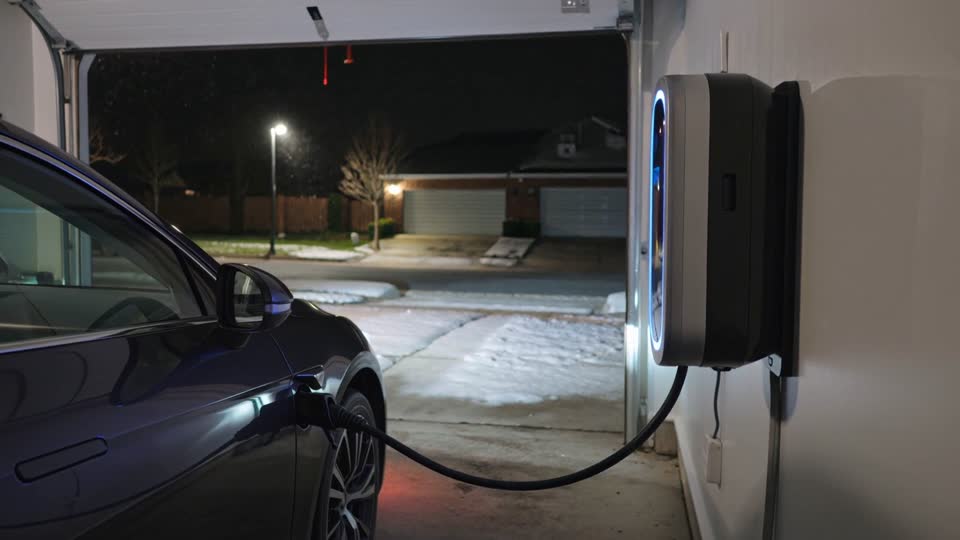
Most of the decision is not the charger. It is how much capacity your service has left, whether the charger can be throttled, and where the car sits on a January night. This guide covers each in the order an electrician looks at them.
Alberta had 20,563 battery-electric vehicles registered in 2025 15, a small share of the fleet but a growing reason for Calgary homeowners to ask about a garage charger. Natural Resources Canada says over 80% of EV owners charge at home 2. Here is what that takes electrically.
CCT 01Level 1 versus Level 2
Both are alternating-current chargers. The difference is voltage, and so how much power reaches the car's on-board charger. NRCan's comparison:
| Level | Input | Outlet | Range added per hour | Time to charge |
|---|---|---|---|---|
| Level 1 | 120 V | Standard receptacle | 3 to 8 km | 8 to 50+ hours |
| Level 2 | 208/240 V | Special outlet or hard-wired unit, like a stove or dryer | 16 to 50 km | 4 to 10 hours |
Source: NRCan 1. NRCan notes that the times vary with the vehicle, battery, charger, tire pressure and temperature. Direct-current fast charging (Level 3) is not suitable for homes.
The same agency puts the average Canadian's driving at about 55 km a day 2. At the low end of Level 1's range, a long overnight plug-in may cover that. A long commute, two EVs or cold weather usually push a household to Level 2. The EV charging time calculator runs the numbers for a given battery and charger size.
CCT 02What a Level 2 circuit involves
NRCan describes a Level 2 charger as a 240 V appliance with electrical requirements like an electric stove or dryer, which must be installed by a licensed electrician in most jurisdictions 2. In practice that means a dedicated two-pole breaker, conductors sized for the charger's current, and a receptacle or hard-wired connection at the parking spot.
Three things decide the size of that circuit:
- The charger's current setting. Many units can be set to draw less than their maximum. Alberta's STANDATA interpretation says a charger whose setting can be changed without an electrician must be counted at its maximum demand in the branch-circuit, service or feeder calculation 3. A charger locked down by the installer can be counted at the setting.
- Charging is continuous. A car can draw full current for hours, so the code treats it as a continuous load and the circuit is sized with headroom above the charger's draw. The calculator above shows the circuit a given charger needs.
- Distance. A long run from a basement panel to a detached garage adds conductor size and cost. Check voltage drop with the voltage drop calculator.
For the hardware and installation side, see EV charger installation.
CCT 03The load calculation: is your service big enough?
For a single dwelling, Rule 8-200 of the Canadian Electrical Code sets how the calculated load is worked out. Alberta's STANDATA bulletin on circuit loading notes that each load rated over 1,500 W goes into the calculation at its nameplate rating 4. A Level 2 charger is well above that line, so it lands in the calculation beside the range, dryer, water heater, air conditioner and any hot tub.
The result decides whether the existing service can carry the charger as it is, or needs one of three changes:
- A lower charger setting, locked by the electrician, if the car's daily need is modest.
- An EV energy management system (below), which lets the charger share capacity instead of adding to the peak.
- A service upgrade, often 100 A to 200 A, which brings in ENMAX Power and a separate permit path. See 100 A vs 200 A service.
Try the home load calculator before you shop for a charger. It shows whether you are near the limit, which is the question every quote turns on.
CCT 04EVEMS: load management instead of an upgrade
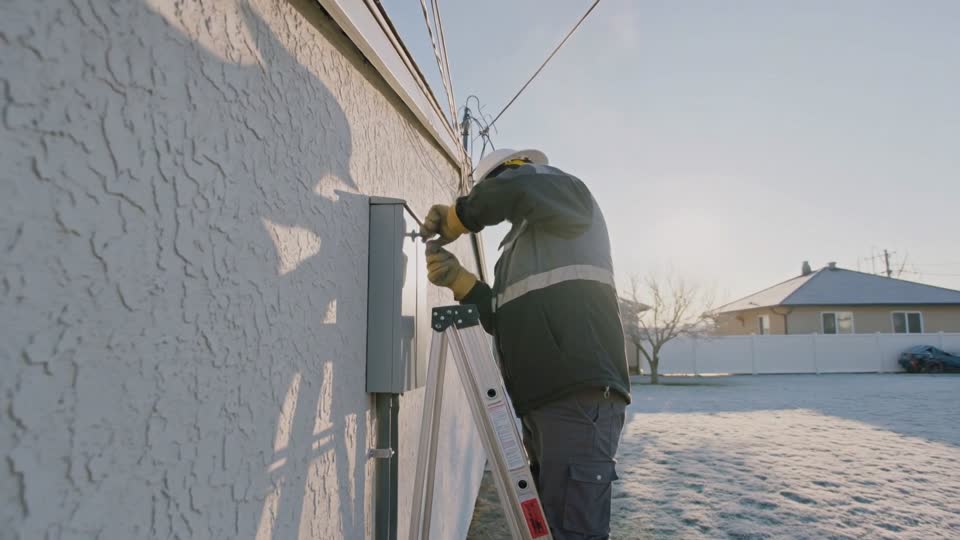
An EV energy management system (EVEMS) watches the home's total load and throttles or pauses the charger when the house is busy, then lets it run at full current when the range and dryer are off. Because the charger can never add to the peak, the code lets the system be taken into account in the calculation, which can avoid a service upgrade.
Two rules shape how it is used in Calgary:
- It is contractor work. The City's homeowner permit page lists EVEMS and load management systems among the work a homeowner may not do under a homeowner permit 5.
- Multi-unit buildings count EVs at full load without it. In apartment-type buildings, EV supply equipment is taken at 100% when calculating individual suite feeders unless an energy management system is used 4. For condos and parkades, see commercial and multi-unit EV charging.
Rowhouses on a shared gang-meter service need one more step: the permit application must include a Row Housing Electrification Authorization form signed by the condo board or homeowner association 6.
CCT 05Permits and who can do the wiring
In Calgary an EV charger requires an electrical permit 6. It is also outside the homeowner permit: the City lists EV charging wiring among the work homeowners may not do 5. A master electrician, certified by the Safety Codes Council, pulls the permit as the contractor 7.
The City's 2026 contractor permit fee is $112 plus $9.79 for every $1,000 of construction value 8, plus a 4% Safety Codes Council fee 8. Starting work before the permit is issued doubles the fee 8. Outside city limits, Airdrie, Cochrane, Chestermere, Okotoks and Rocky View County run their own permits.
Safety
Electrical work in Alberta needs a permit. EV charger wiring in Calgary needs a contractor permit, most other work needs a certified electrician, and homeowner permits have limits. Never open a panel or work on energized equipment. Plugging a charger into an old dryer or welder receptacle with an adapter is not a substitute for a circuit designed for continuous charging.
The permits guide covers inspections and what happens without a permit.
CCT 06What charging costs on an ENMAX-area bill
Frame this carefully, because Alberta's default rate changed. The Rate of Last Resort replaced the Regulated Rate Option on January 1, 2025 9. It is the default energy rate for customers without a retail contract. For customers in the ENMAX Power distribution area, which covers Calgary, the Rate of Last Resort is 12.06¢ per kWh, fixed through December 31, 2026 10.
That figure is the energy charge only. Delivery, transmission and administration charges are extra, so the all-in cost of a kWh is higher. As arithmetic on the published rate, every 100 kWh put into a car costs $12.06 in energy charges alone at 12.06¢ per kWh. Customers on a retail contract pay their contract's energy rate instead.
To estimate your own number, enter the charger's kW, hours and your all-in price in the appliance running cost calculator. NRCan suggests smart chargers that can schedule charging for off-peak periods 2. That only saves money if your retail plan prices time of day differently.
On installation cost, NRCan lists the drivers (the unit, the home's electrical capacity, permits and labour) and notes rebates of up to 50% of installation cost in some provinces 2. It publishes no dollar range for home installation. The EV charger installation cost guide covers what moves a Calgary quote.
CCT 07Designing for a Calgary winter
Calgary's January 2.5% design temperature is −30 °C, and the 1% value is −32 °C 11. NRCan notes that temperature affects both charging time and range 1. A cold battery accepts charge more slowly, and cabin heating uses energy, so winter is when a marginal Level 1 setup falls short.
- Garage or driveway. NRCan advises an outdoor-rated charger for an outdoor space 2. Outside, plan the cable route clear of snow clearing and ice.
- Plug in when you park. Most EVs can warm the battery and cabin from the grid while plugged in, which saves range on cold mornings.
- Protection at outdoor outlets. The City's homeowner wiring guide says exterior outlets within 2.5 m of finished grade must be GFCI protected, but automotive heater and charging outlets are exempt 12. The guide is labelled as including 2021 code amendments, so an electrician confirms the current rule.
Block heaters and EV chargers often share a driveway. See winter electrical in Calgary for outdoor receptacles and cold-snap loads. To have a charger priced, request a quote and a person replies.
Questions people ask
Do I need a permit for an EV charger in Calgary?
Yes. The City requires an electrical permit for an EV charger, and EV charging wiring is on the list of work homeowners may not do under a homeowner permit. An electrical contractor pulls the permit, and the work is inspected.
Is 100 amp service enough for an EV charger?
Sometimes. It depends on the load calculation: what else the house has (electric range, dryer, air conditioning, hot tub) and the charger setting. A lower locked setting or an EV energy management system can fit a charger on a 100 A service that could not carry it at full current. The home load calculator gives a first answer; an electrician confirms it.
Can a normal electrician install an EV charger?
Yes. In Alberta the work is done by a certified journeyperson electrician, or a registered apprentice under one 13, and the permit is pulled by a contractor holding a master electrician certificate 7. No separate EV licence applies. The job is a dedicated 240 V circuit plus, where needed, load management or a service change. Ask whether the quote includes the permit and the load calculation.
How much does it cost to charge an electric car in Alberta?
Multiply the kWh you put in by your all-in price per kWh. In the ENMAX Power area the default Rate of Last Resort energy charge is 12.06¢ per kWh through December 31, 2026 10, but that excludes delivery charges, so your real price is higher. Retail contract customers use their own rate.
Do I need a Level 2 charger, or is Level 1 enough?
NRCan estimates Level 1 adds 3 to 8 km of range per hour and Level 2 adds 16 to 50 km 1. If you drive little and park for long stretches, Level 1 may cover it in mild weather. Long commutes, two EVs and Calgary winters usually favour Level 2.
Is there an EV charger rebate in Alberta?
NRCan says rebates of up to 50% of home charger installation cost exist in some provinces 2, but no Alberta home-charger rebate appeared in the official sources reviewed for this page. Calgary's ChargeYYC program was for multi-unit residential buildings, and its first intake closed on November 18, 2025 14. Check current status before you plan around one.
Sources
- Electric vehicle chargingNatural Resources Canada · modified 2026-07-22
- Electric vehicle charging: Charger installationNatural Resources Canada · modified 2026-07-22
- STANDATA interpretation 24-ECI-086 Electric vehicle charging systemsAlberta Municipal Affairs · April 2025
- STANDATA bulletin 24-ECB-008 Circuit loading and demand factorsAlberta Municipal Affairs · April 2025
- Homeowner electrical and plumbing permitsCity of Calgary · retrieved 2026-09-25
- Electrical permits for contractorsCity of Calgary · retrieved 2026-09-25
- About Master ElectriciansSafety Codes Council · retrieved 2026-09-25
- 2026 Building & Trade Permit Fee Schedule (R2026-02)The City of Calgary · 2026 fee schedule, revision R2026-02; retrieved 2026-09-25
- Utilities Consumer Advocate: Rate of Last ResortGovernment of Alberta (Utilities Consumer Advocate) · Effective 2025-01-01; page read 2026-09-25
- Utilities Consumer Advocate: Default ratesGovernment of Alberta (Utilities Consumer Advocate) · Fixed 2025-01-01 to 2026-12-31; page read 2026-09-25
- National Building Code - 2023 Alberta Edition, Volume 1, Division B, Appendix C, Table C-2 Climatic Design Data for Selected Locations in AlbertaAlberta Municipal Affairs / National Research Council of Canada · 2023 Alberta Edition, second printing incl. revisions and errata released April 2026
- Homeowners electrical wiring guide (labelled as including 2021 CE Code amendments)The City of Calgary · copyright 2024
- Compulsory Certification TradesGovernment of Alberta (Tradesecrets) · retrieved 2026-09-25
- ChargeYYCThe City of Calgary · Page retrieved 2026-09-25
- Table 23-10-0308-01 Vehicle registrations, by type of vehicle and fuel typeStatistics Canada · 2025 reference year; released 2026-09-22
Related
-
E-401
Electrical permits in Calgary
When you need an electrical permit in Calgary, homeowner versus contractor permits, inspections and what happens without one.
-
E-402
Hiring an electrician
Certification, master electricians, permits, insurance, quotes and contracts: what to check before anyone opens your panel.
-
 E-403
The electrical code in Alberta
Which edition of the Canadian Electrical Code applies in Alberta, how Alberta amends it, and where STANDATA bulletins fit.
E-403
The electrical code in Alberta
Which edition of the Canadian Electrical Code applies in Alberta, how Alberta amends it, and where STANDATA bulletins fit.