Commercial · Drawing E-205
EV charging for condos, workplaces and fleets in Calgary
Charging dozens of cars from one building service is a capacity problem first and a charger problem second. Here is how Calgary condos, workplaces and fleets plan it.
CCT 01Start with the building, not the charger
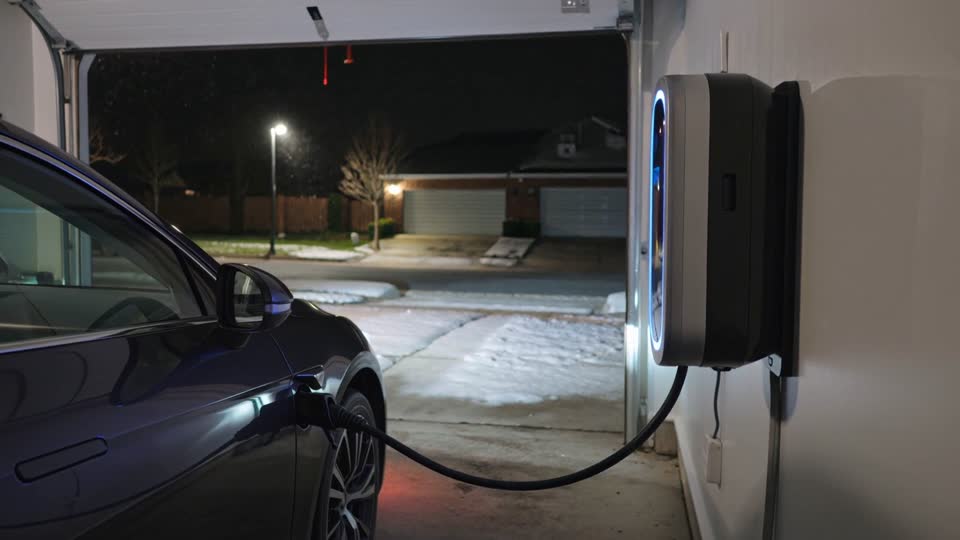
A single charger in a detached garage is a residential job (see EV charger installation). A condo parkade, a workplace lot or a fleet yard is different. The chargers share one service, the wiring crosses common property, and the decision belongs to a board, a landlord or a fleet manager rather than one driver. Every installation needs a City of Calgary electrical permit 1, taken out by a contractor; the permits guide explains how that works.
Condo owners often ask whether they can do the work themselves. They cannot. Calgary does not issue homeowner permits for apartment-style condominiums 2, and homeowner permits exclude EV-charging wiring and EV energy management systems in every housing type 2. For rowhouses on a shared gang meter base, the City also requires a Row Housing Electrification Authorization form, signed by the condo board or homeowner association, with the permit application 1.
Demand is early but growing. Alberta had 20,563 battery-electric vehicles registered in 2025 3, about 0.54% of all registered road vehicles 3. That is a count of vehicles on the road, not new sales. Buildings that plan the electrical backbone now avoid cutting into a finished parkade later. Residents weighing Level 1 against Level 2 can start with EV charging at home.
CCT 02How the code counts EV load, and what EVEMS changes
Chargers are continuous loads that run for hours, often all at once in the evening. Alberta's STANDATA bulletin on circuit loading, 24-ECB-008, says that where no EV energy management system is used, EV supply equipment is taken at 100% when calculating individual suite feeders in apartment-type buildings (Rule 8-202) 4. A separate interpretation, 24-ECI-086, says chargers whose ampacity setting can be changed without an electrician must be counted at their maximum demand for the branch circuit, feeder or service 5.
That is why EVEMS exists. An EV energy management system monitors the load on a feeder or service and throttles or schedules the chargers so their combined draw stays under a set limit. With one, a parkade can connect far more chargers to the same capacity, accepting that each car charges more slowly when many are plugged in. Without one, the calculation assumes every charger runs flat out.
What to settle early:
- Which feeder or service the chargers will hang from, and its spare capacity from a load study. Measured demand beats nameplate guesses.
- Whether load is managed at the chargers (networked load sharing) or at the panel (an EVEMS controlling circuits).
- The power each stall gets at full occupancy. Most commuters need far less than a charger's maximum overnight; the EV charging time calculator shows the range added per hour at a given power.
- Who can change charger settings. If a user can raise the limit without an electrician, the calculation must use the maximum.
Safety
EV charging work in Alberta needs a permit and a certified electrician; Calgary's homeowner permit does not cover EV-charging wiring or load management at all. Do not open panels, splitters or chargers to add or reroute circuits yourself, and never work on energized equipment.
CCT 03Capacity, ENMAX and the parkade service
Most existing parkades were never designed for charging. The service was sized for lighting, ventilation fans, elevators and suites. If the load study shows it is short, the choices are to manage the load harder, add a separate service for charging, or upgrade the existing one. The last two involve ENMAX:
- Services over 200 A need ENMAX CT metering, with a CT request form and installation checklist 6.
- The City requires plans and drawings for new services or upgrades of 600 A and higher 1.
- ENMAX prices a service change with its (A − B) + C − D + E + F formula, crediting its investment in the new load 7. For 2026 that investment is $14,675 per meter for small commercial (D200) new load 8, or, for larger D300/D310 customers, up to $367 per kVA of minimum contract demand on a 15-year agreement 8.
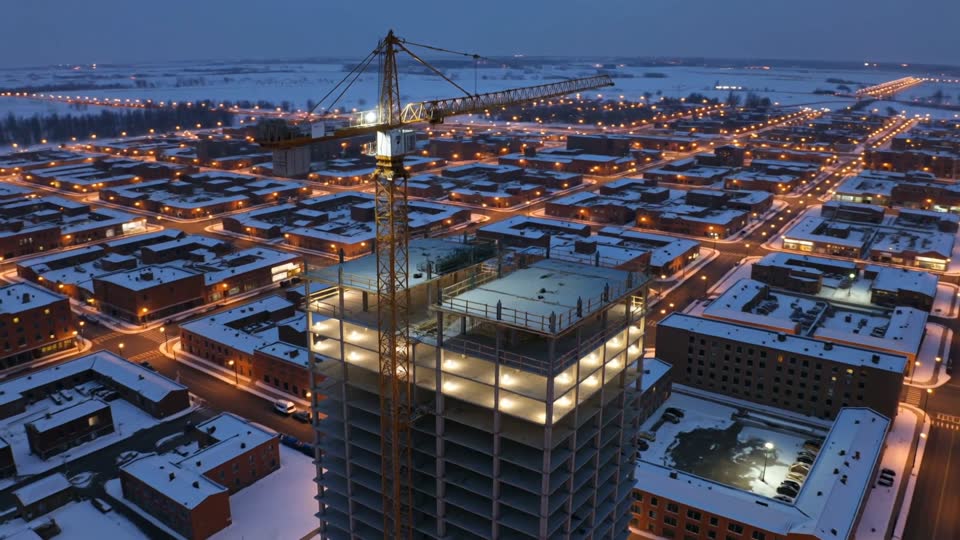
For a new building, EV capacity has to be in the utility application from day one: ENMAX does not confirm capacity when it reviews a circulated development permit 1. Commercial new construction sets out that sequence. Power distribution and switchgear explains the service side, and multi-family and high-rise covers parkade systems in new towers.
CCT 04What multi-unit charging costs: the national estimates
No City, provincial or federal body publishes an installed price for condo or workplace charging in Calgary. The most useful official reference is a study Dunsky Energy + Climate Advisors prepared for Natural Resources Canada, published in February 2024. Its figures are national planning estimates for public charging, in 2022 dollars, not quotes for a Calgary parkade:
| Charger type | 2025 | 2030 |
|---|---|---|
| Public Level 2 | $15,000 9 | $10,000 |
| DC fast charger | $160,000 (125 kW average) 9 | $240,000 (175 kW average) |
The study also notes that on-street Level 2 installations can easily exceed $20,000 per port, compared with chargers in off-street parking lots 9. A parkade will not match either figure: it skips pedestals and payment hardware, but adds concrete coring, conduit routed around sprinkler lines and fire-separation penetrations. Treat the figures as order-of-magnitude only, allow for inflation since 2022, and price the actual building.
What moves the price in a Calgary parkade:
- Spare capacity, and whether a service upgrade or new service is needed.
- Distance from the electrical room to the stalls, and whether conduit can be surface-mounted or the slab must be cored.
- EV-ready (a circuit or conduit to each stall, charger added later) versus chargers installed now.
- The load management platform and any network subscription.
- The permit, priced on construction value at $112 plus $9.79 per $1,000 10.
The single-charger case is covered in EV charger installation cost.
CCT 05ZEVIP and ChargeYYC: both closed as of September 2026
ZEVIP (federal). Natural Resources Canada's Zero Emission Vehicle Infrastructure Program funded multi-unit residential, workplace, fleet and public charging. NRCan's contribution is limited to 50% of total project costs, up to $2 million per project 11. Both streams, for charger owners and operators and for delivery organizations, were closed for applications when this page was checked 11.
ChargeYYC (City of Calgary). The City's program for existing multi-residential buildings had three parts:
- A road map grant covering the lower of $4,000 or 50% of the cost of an EV Charging Road Map for the building 12.
- The EV Enabled Rebate: 50% of eligible infrastructure costs to make parking EV-ready, up to $6,000 per stall and $90,000 per property 12.
- The EV Charger Rebate: 50% of Level 2 charger purchase and installation, up to $1,000 per single-port or $2,000 per dual-port station, to $10,000 per property 12.
The initial intake closed on November 18, 2025, and the City says it anticipates reopening the program in the future 12. These are rebate caps, not cost benchmarks. A board planning now should keep its road map, load study and quotes in a form that would suit a future intake, without counting on the money. When the scope is clear, request a quote and a person replies.
CCT 06A road map for a condo or workplace
- Inventory. Stalls, how parking is assigned, the electrical rooms serving the parkade, and the existing drawings.
- Load study. Measured demand on the service and feeders, ideally including a cold snap. Alberta's system demand peaks in winter: the provincial record, 12,785 MW, was set on December 11, 2025 13.
- Options. EV-ready wiring to every stall with chargers added on request, a shared bank of chargers, or a mix, each with a load management approach and a way to recover energy and equipment costs.
- Governance. Board or owner approval, and bylaws or lease terms setting who pays for what. The condo's lawyer should confirm the approach.
- Design and permit. Drawings where the service size requires them, the electrical permit, and the gang-meter authorization form for rowhouse complexes.
- Install, inspect, commission. The contractor proves load management works at full occupancy before handing over.
Winter details matter in Calgary, where the January 2.5% design temperature is −30 °C 14: charger ratings for heated versus unheated parkades, cable management that keeps cords off wet, salted slabs, and snow clearing around outdoor pedestals.
CCT 07Workplaces, fleets and DC fast charging
Workplaces usually suit Level 2: cars sit for hours, so modest power per stall is enough, and load management lets many stalls share a feeder. Fleets that return to a yard overnight can often do the same. Fleets that need a fast turnaround, such as delivery vans running two shifts, need DC fast chargers, often called Level 3.
DC fast charging changes the scale of the electrical job. The NRCan-commissioned study priced a fast-charger port at $160,000 in 2025 (2022 dollars) and assumed a 125 kW average, rising to 175 kW by 2030 9, so a small bank of fast chargers can add as much load as a small office building. That almost always means a new or upgraded service, CT metering, engineered drawings, and a conversation with ENMAX about the investment level and minimum contract demand. Ask for the ENMAX estimate early; for a large connection, the utility share can decide whether a site is viable.
Fleet depots should also plan for growth: conduit and pad space for the next chargers, a switchboard with spare sections, and a load management system that can schedule charging around departure times. The running cost calculator gives a first estimate of energy cost per vehicle.
Questions people ask
How much does it cost to install EV chargers in a condo parkade?
No official Calgary figure exists. The only official per-port reference is a national planning estimate: $15,000 per public Level 2 port in 2025, in 2022 dollars 9. A parkade's price depends on spare capacity, distance to the stalls, concrete and conduit work, EV-ready versus installed chargers, and load management. Get a load study first.
Can a condo owner install their own EV charger in Calgary?
What is an EV energy management system (EVEMS)?
A control system that limits the combined draw of a group of chargers so it stays within the capacity of a feeder or service. Without one, Alberta's STANDATA guidance counts EV equipment at 100% on apartment suite feeders 4, which quickly uses up a building's spare capacity.
Is ChargeYYC still open?
What are the power requirements for a Level 3 EV charger?
They are far larger than Level 2. The NRCan-commissioned study assumed an average of 125 kW per fast-charger port in 2025, at a national planning cost of $160,000 per port in 2022 dollars, and 175 kW by 2030 9. Most sites need a service upgrade or a new service with CT metering, so start with ENMAX and an electrical engineer, not the charger catalogue.
Sources
- Electrical permits for contractorsCity of Calgary · retrieved 2026-09-25
- Homeowner electrical and plumbing permitsCity of Calgary · retrieved 2026-09-25
- Table 23-10-0308-01 Vehicle registrations, by type of vehicle and fuel typeStatistics Canada · 2025 reference year; released 2026-09-22
- STANDATA bulletin 24-ECB-008 Circuit loading and demand factorsAlberta Municipal Affairs · April 2025
- STANDATA interpretation 24-ECI-086 Electric vehicle charging systemsAlberta Municipal Affairs · April 2025
- Get the power flowingENMAX Power Corporation · retrieved 2026-09-25
- ENMAX Power Corporation Distribution Tariff, Customer Terms and ConditionsENMAX Power Corporation · Effective January 1, 2026
- ENMAX Power Corporation Distribution Tariff, Terms and Conditions Investment Level ScheduleENMAX Power Corporation · Effective January 1, 2026 (applies January 1 to December 31, 2026)
- Electric Vehicle Charging Infrastructure for Canada (Dunsky Energy + Climate Advisors for NRCan)Natural Resources Canada · 2025 estimate in 2022 dollars; published February 2024; page modified 2025-01-08
- 2026 Building & Trade Permit Fee Schedule (R2026-02)City of Calgary · 2026 schedule R2026-02
- Zero Emission Vehicle Infrastructure ProgramNatural Resources Canada · Page modified 2026-03-20
- ChargeYYCThe City of Calgary · Phases 1 and 2 closed; page retrieved 2026-09-25
- AESO 2025 Annual Market Statistics (March 2026)Alberta Electric System Operator (AESO) · Calendar 2025; winter peak through Feb 2026; published March 2026
- National Building Code - 2023 Alberta Edition, Volume 1, Division B, Appendix C, Table C-2 Climatic Design Data for Selected Locations in AlbertaAlberta Municipal Affairs / National Research Council of Canada · 2023 Alberta Edition, second printing incl. revisions and errata released April 2026
Related
-
 E-201
Tenant improvements
Office, retail and restaurant fit-outs: the drawings, permits, lighting, power and data an electrical contractor prices.
E-201
Tenant improvements
Office, retail and restaurant fit-outs: the drawings, permits, lighting, power and data an electrical contractor prices.
-
 E-202
LED lighting retrofits
Replacing fluorescent, metal halide and HID lighting with LED and controls in warehouses, offices and parking structures.
E-202
LED lighting retrofits
Replacing fluorescent, metal halide and HID lighting with LED and controls in warehouses, offices and parking structures.
-
 E-203
Power distribution & switchgear
Services, switchgear, transformers and distribution for commercial buildings: capacity, coordination and shutdown planning.
E-203
Power distribution & switchgear
Services, switchgear, transformers and distribution for commercial buildings: capacity, coordination and shutdown planning.