Commercial · Drawing E-202
LED lighting retrofits in Calgary
An LED retrofit is one of the few electrical projects that can pay for itself. Whether it does depends on the hours, the fixtures and the price of power, not on a vendor’s savings claim.
Most commercial buildings in Calgary still have some fluorescent troffers, metal halide high-bays, high-pressure sodium wall packs or old exit signs. Replacing them with LED is simple in principle. In practice the choices (lamp, kit or new fixture; which controls; one permit or an annual permit) decide both the safety of the result and whether the savings are real.
CCT 01What an LED retrofit replaces
The typical targets, and why they are worth doing:
- Fluorescent troffers and strip lights in offices, schools and back-of-house areas. The ballasts are ageing, the lamps contain mercury, and output drops in cold spaces.
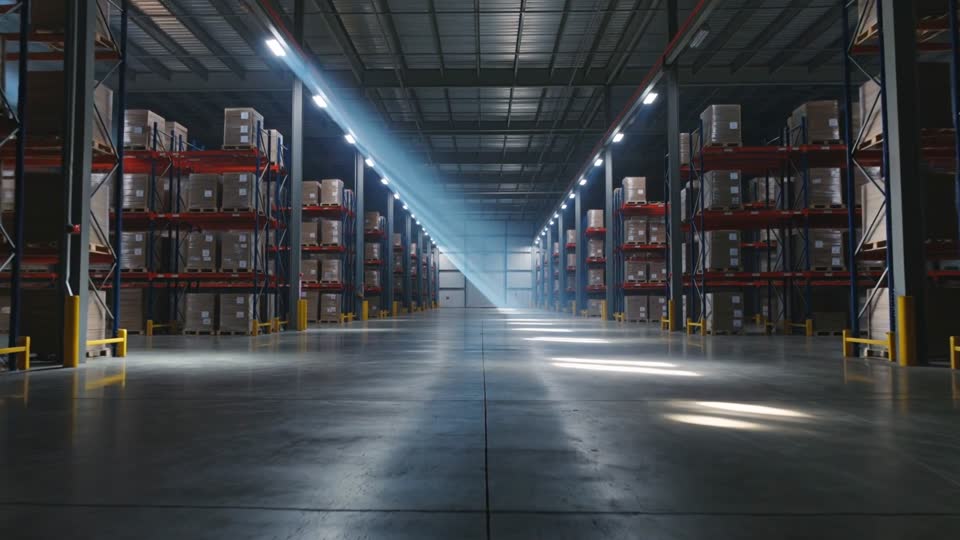
- Metal halide and high-pressure sodium high-bays in warehouses, shops and arenas. They take minutes to restrike after a power blip, lose output well before they fail, and are hard to reach for relamping.
- Parkade fixtures, which often burn around the clock and are among the easiest wins when paired with occupancy controls.
- Exterior wall packs, canopy lights and pole lights, which run all night through Calgary's long winter evenings.
- Exit signs and emergency lighting units, where LED versions draw less power and do away with lamp replacement.
Homeowners replacing recessed cans with LED retrofit trims are doing a smaller version of the same thing. See lighting and pot lights for the residential side.
CCT 02Lamp, kit or new fixture
There are three ways to put LED into an existing space. The right one depends on the condition of the fixtures, the ceiling and how long you plan to stay.
| Approach | What changes | Watch for |
|---|---|---|
| Ballast-compatible LED tube (“Type A”, plug-and-play) | Lamps only; the existing ballast stays | Savings are limited by the ballast, and the next ballast failure puts you back on a ladder |
| Ballast-bypass LED tube (“Type B”, direct wire) | Ballast removed; line voltage wired to the lamp holders | Fixture rewiring, correct lamp holders, a warning label, and a hazard if someone later installs a fluorescent tube |
| Retrofit kit (door kit, LED panel insert, high-bay kit) | New LED light engine and driver in the existing housing | Kit certified for that housing, installed to its instructions, and the fixture marked as modified |
| New fixture | Whole luminaire replaced | Highest material cost, but new warranty, better optics and built-in sensors |
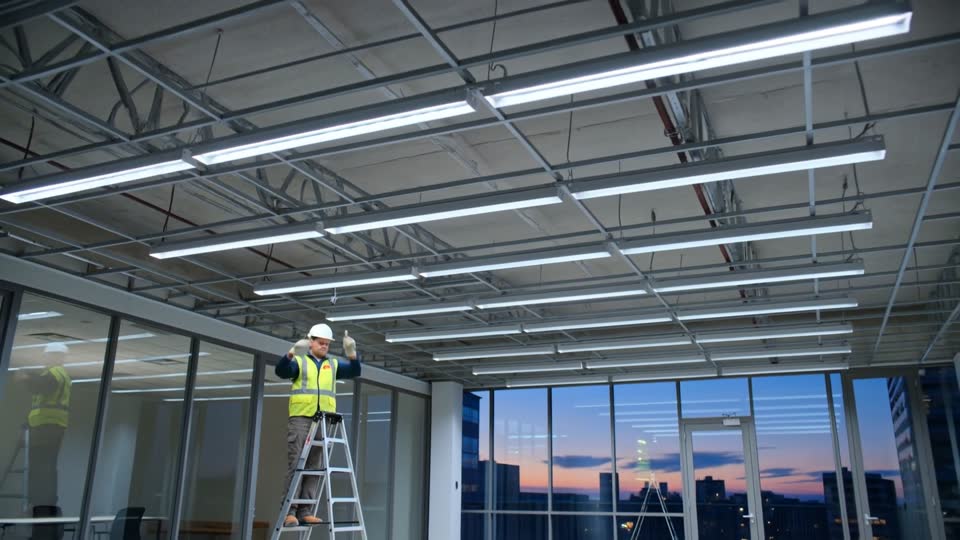
Ballast bypass deserves a closer look, because it is the most common source of problems in later maintenance. Single-ended bypass tubes need the right kind of lamp holder, and the original holders in many instant-start fixtures are the wrong kind. Once a fixture has been converted, nothing but the label stops someone from fitting a fluorescent tube. In warehouses, the choice is usually between a high-bay kit and a new fixture. At high mounting heights the lift and labour cost the same either way, so new fixtures with integral sensors often win.
Safety
Converting fixtures is electrical work. In Alberta it needs a permit where wiring is altered, and it must be done by certified electricians. Homeowner permits do not apply to commercial buildings. Ballast-bypass wiring puts line voltage at the lamp holders, so never relamp or open a fixture without isolating the circuit. High-bay work also means lifts and fall protection. Do not work on energized fixtures or panels. That includes “just swapping tubes” on a live circuit.
CCT 03Controls and the energy code
LED fixtures cut the watts. Controls cut the hours, and in many buildings the hours are the bigger lever. The common control strategies are:
- Occupancy and vacancy sensors in offices, washrooms, storage rooms and warehouse aisles, including high-bay sensors that dim to a low level rather than switching off.
- Bi-level parkade lighting that drops to a set-back level when no one is moving.
- Daylight-responsive dimming near windows and skylights, usually over an analogue (0–10 V) or digital control wire.
- Schedules and networked controls for large floors, with reporting that proves actual run hours.
The National Energy Code of Canada for Buildings 2020 came into force in Alberta on May 1, 2024 1, and Alberta adopted Tier 1 of it as the minimum for buildings outside Part 9 1. The code limits lighting power and requires automatic controls in new construction, and it can apply to alterations depending on scope. We have not verified its specific lighting power allowances, so they are not quoted here. Ask the designer or contractor to confirm whether your retrofit triggers compliance.
Emergency lighting has a detail that retrofits often miss. Receptacles serving battery unit equipment must be at least 2.5 m above the floor where practicable and within 1.5 m of the unit 2.
CCT 04Permits: one job, or an annual permit
The City of Calgary requires an electrical permit for new wiring and whenever existing branch-circuit wiring is extended or altered 3. Its homeowner guidance says that replacing fixtures only does not need a permit 3. Most commercial retrofits go further, with ballast bypass, new fixtures on new supports, sensor wiring and re-circuiting. Have the contractor confirm the permit position with the City rather than assume the job is exempt.
Facilities with ongoing electrical work have another option. The City's annual electrical permit covers facilities with a full-time journeyman electrician, or with contractor maintenance work, and costs $162.24 in 2026 including the Safety Codes Council fee 4. The City issued 232 annual facility permits in 2025, and 687 across 2023 to 2025, of which 549 were at non-residential addresses 5. More permit figures are on the Calgary electrical data page. A phased retrofit carried out by the facility's maintenance electrician may fall under it. A large project priced and delivered as a single contract usually takes its own permit.
For a single-project permit, the contractor fee is $112 plus $9.79 for each $1,000 of construction value 4. Construction value includes customer-supplied materials 4, so fixtures bought by the owner still count. In a multi-tenant building, base-building and tenant spaces take separate electrical permits 6. These are City of Calgary rules. Facilities in Rocky View County, Airdrie or other municipalities follow their own permit authority. See the permits guide for the process and permit fees for the full 2026 schedule.
CCT 05Working out payback without invented savings
Vendor savings claims are usually a percentage with no stated baseline. A defensible payback uses your own numbers:
- Existing load. Count fixtures by type and use the input watts, including the ballast, not the lamp's nominal wattage. A clamp-meter reading on a lighting circuit settles arguments.
- New load. The LED fixture's rated input watts from its specification sheet.
- Hours. Actual annual run hours by area, from schedules, a data logger or the building automation system. Then estimate how far controls will cut them.
- Energy saved. The watts saved times the hours, divided by 1,000, gives kWh a year.
- Value. Multiply by your energy price, using your own bill. Default-rate customers pay an energy charge of 12.06¢/kWh in ENMAX's area through 2026, and that excludes delivery and administration charges 7. Many commercial accounts buy on a retail contract, and larger accounts also pay demand charges based on peak kW, which lighting reductions lower too.
- Payback. Net installed cost divided by annual savings, plus the maintenance you no longer do: relamping lifts, ballast replacements and lamp disposal.
The appliance running cost calculator does steps 4 and 5 for any load: enter the old and new watts and hours, and compare. One Calgary-specific effect: in a heated building, lighting waste heat offsets a little heating in winter. Calgary has 5,000 heating degree-days a year 8, so some of the winter saving comes back as furnace or boiler load. It is small in most buildings, but honest payback calculations mention it.
On incentives: as of September 2026 we found no open Alberta or City of Calgary business lighting rebate. The City's Commercial Clean Energy Improvement Program intake is paused 9. Check current programs before counting any incentive in the payback.
CCT 06What drives the price of a retrofit
No official body publishes per-fixture or per-square-foot retrofit prices for Calgary. The drivers are predictable:
- Approach. Tubes, kits or new fixtures (above), and how many fixture types are involved.
- Access. Mounting height, lifts, racking, occupied offices and operating warehouses. Work around operations often means nights or weekends.
- Controls. Standalone sensors cost little. Networked systems need programming, commissioning and training.
- Emergency and exit lighting, which must work at the end, and may need testing after conversion.
- Disposal. Fluorescent and HID lamps contain mercury, and some older magnetic ballasts contain PCBs. The quote should say who handles recycling and hazardous waste.
- Permits and verification, including a photometric check where light levels matter, for example in racking aisles or at loading docks.
Construction costs for the electrical trade in Calgary are measurable. Statistics Canada's non-residential electrical price index for Calgary was 111.3 in the second quarter of 2026 (2023 = 100) 10, up 1.0% on a year earlier 10. The 15-city composite rose 1.8% over the same period 10. These index contractors' costs, not a retrofit price. See commercial electrical cost for how commercial work is priced.
CCT 07Calgary conditions: cold, parkades and outdoor lighting
Calgary's January design temperature is -30 °C 8. Fluorescent lamps in unheated warehouses, loading docks and parkades lose output badly in that cold, while LEDs generally run better in the cold. Check that the driver's rated operating range covers an unheated space. Exterior fixtures need the same check, plus gaskets and photocells that survive freeze-thaw.
Parkades in condos and office towers are some of the best retrofit candidates, because the lights run constantly. They are also where emergency lighting, sensors and a corrosive, salty environment meet. The multi-family and high-rise page covers parkade electrical more broadly. In industrial buildings, lighting is usually one line in a wider maintenance program with infrared scanning and shutdown planning. See maintenance and thermography and industrial electrical. If the retrofit is part of a wider fit-out, tenant improvements explains the permits and drawings.
Questions people ask
What is an LED retrofit kit?
A retrofit kit is a new LED light engine and driver built to fit inside an existing fixture housing, such as a 2x4 troffer, a high-bay or a recessed can. It keeps the housing and ceiling intact while replacing everything that makes light. The kit must be certified for the kind of housing it goes into, installed to its instructions, and the fixture labelled as modified.
Is ballast bypass LED safe?
It is safe when installed correctly and labelled: the ballast is removed, the lamp holders are the right type, and the fixture is marked for LED tubes only. The risk comes later, when someone relamps with a fluorescent tube or works on the fixture assuming it is low voltage. In buildings with many people changing lamps, kits or new fixtures avoid that risk.
Why are my LED retrofit lights flickering?
The usual causes are a dimmer or control that is not compatible with the driver, a failing ballast behind ballast-compatible tubes, mixed lamp types on one ballast, a loose connection or neutral, or a failing driver. Flicker in a newly retrofitted area almost always traces back to compatibility. Have an electrician check the ballast or driver and the control wiring before replacing lamps again.
Do I need a permit for an LED lighting retrofit in Calgary?
Often, yes. Calgary requires a permit when branch-circuit wiring is altered or extended 3, and most commercial retrofits alter wiring (ballast bypass, new fixtures, sensors). Facilities with ongoing maintenance work may use the City's annual electrical permit, which costs $162.24 in 2026 4. Confirm the permit route with the City before work starts.
Is there an Alberta business LED lighting rebate program?
We found none open as of September 2026. The City of Calgary's Commercial Clean Energy Improvement Program, which finances energy upgrades, has paused intake 9. Programs change, so check current federal, provincial and City offers before you sign, and base the decision on payback without an incentive.
Sources
- Notice: New Alberta codes editions (NBC(AE) 2023, NFC(AE) 2023, NECB 2020)Alberta Municipal Affairs · April 2024
- STANDATA interpretation 24-ECI-046 Emergency power supply, unit equipment, exit signs, and life safety systemsAlberta Municipal Affairs · April 2025
- Homeowner electrical and plumbing permitsCity of Calgary · retrieved 2026-09-25
- 2026 Building & Trade Permit Fee Schedule (R2026-02)The City of Calgary · 2026 fee schedule, revision R2026-02; retrieved 2026-09-25
- Electrical Permits and Inspections (dataset vxgy-id5s)The City of Calgary, Open Government Licence – City of Calgary · queried 2026-09-25
- Electrical permits for contractorsCity of Calgary · retrieved 2026-09-25
- Utilities Consumer Advocate: Default ratesGovernment of Alberta (Utilities Consumer Advocate) · Fixed 2025-01-01 to 2026-12-31; page read 2026-09-25
- National Building Code - 2023 Alberta Edition, Volume 1, Division B, Appendix C, Table C-2 Climatic Design Data for Selected Locations in AlbertaAlberta Municipal Affairs / National Research Council of Canada · 2023 Alberta Edition, second printing incl. revisions and errata released April 2026
- Commercial Clean Energy Improvement ProgramCity of Calgary · Page read 2026-09-25
- Table 18-10-0289-01 Building construction price indexes, by type of building and divisionStatistics Canada · Q2 2026 (April-June 2026); released 2026-07-24
Related
-
E-201
Tenant improvements
Office, retail and restaurant fit-outs: the drawings, permits, lighting, power and data an electrical contractor prices.
-
 E-203
Power distribution & switchgear
Services, switchgear, transformers and distribution for commercial buildings: capacity, coordination and shutdown planning.
E-203
Power distribution & switchgear
Services, switchgear, transformers and distribution for commercial buildings: capacity, coordination and shutdown planning.
-
 E-204
Industrial electrical
Motor feeders, controls, process equipment, cable tray and hazardous locations in plants, shops and warehouses.
E-204
Industrial electrical
Motor feeders, controls, process equipment, cable tray and hazardous locations in plants, shops and warehouses.