Commercial · Drawing E-207
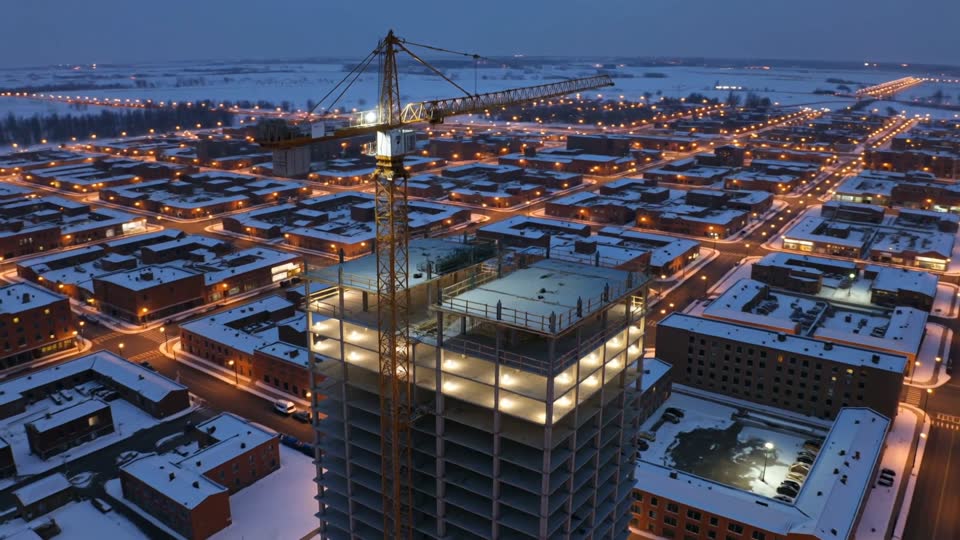
Multi-family and high-rise electrical in Calgary
How power reaches every suite in a Calgary condo, apartment or mixed-use tower, and what a board, manager or developer needs to know before changing any of it.
A multi-family building is one electrical service split hundreds of ways. The utility delivers power to a main switchboard, a metering arrangement divides it between owners, and risers carry it up to each floor. Life-safety systems ride on top of all of that. Every change a board or developer makes, from a parkade charger to a new fire alarm panel, has to fit that whole system, not just the suite in front of the electrician.
CCT 01How power is laid out in a condo or apartment tower
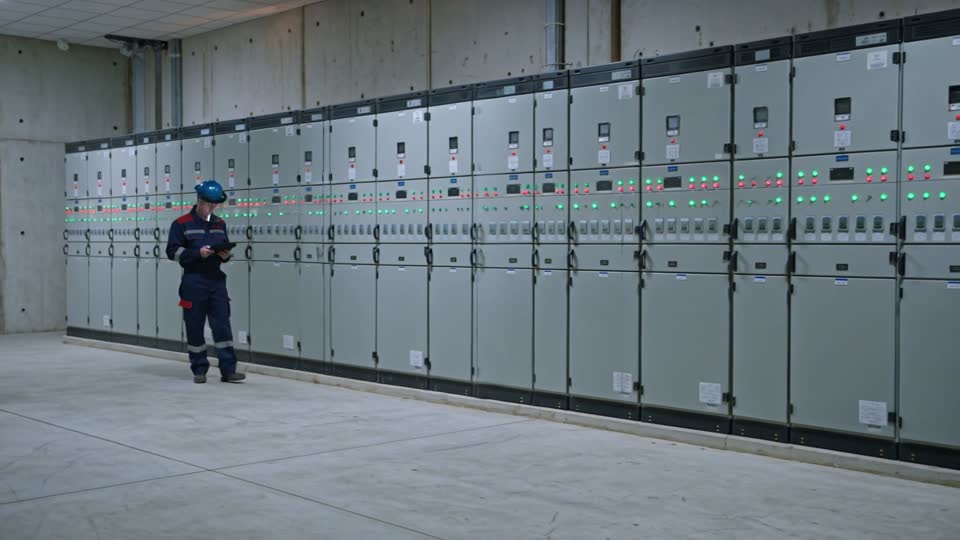
Most Calgary mid-rise and high-rise buildings follow the same path. ENMAX Power delivers the supply to a transformer (pad-mounted outside or in an electrical vault), which feeds the building's main switchboard. From there, feeders run to metering centres, to the house or common-area distribution (corridors, elevators, parkade fans, pumps, make-up air units) and to life-safety equipment.
Larger buildings have services above 200 A, and those use ENMAX current-transformer (CT) metering at the main, and the contractor submits ENMAX's CT request form and installation checklist.1 Where a new or upgraded service is 600 A or more, the City of Calgary requires plans and drawings with the permit application, including for all high-voltage installations.2
Above the main, power travels up the building by one of two routes:
- Bus duct risers. An enclosed busway runs up a shaft with plug-in or tap boxes at each floor. It suits tall towers with many suites on each floor.
- Cable feeders. Individual feeders run from a ground-floor meter room to suite panels, or from floor meter rooms to suites. This layout is common in wood-frame mid-rise buildings.
The layout decides what is easy later. A bus duct riser with spare capacity can take new loads floor by floor. A building whose suite feeders were sized tightly to the original load calculation cannot, which matters when owners start asking for chargers and heat pumps. For the switchgear side of a building, see power distribution and switchgear.
CCT 02Suite metering: utility meters, bulk meters and submeters
There are two basic ways to bill suites in Calgary, and the choice is made when a building is designed.
- Individual utility meters. Each suite has its own ENMAX meter, usually in a meter stack on the ground floor or on each floor. Each owner picks a retailer and pays ENMAX's distribution tariff through their own bill. The condo corporation has a separate account for common property.
- Bulk metering with submeters. ENMAX meters the whole building, and the owner or a billing company reads private submeters to split the cost among suites. Submeters used to charge individual purchasers in a multiple-unit complex are revenue meters under federal law. They must be of an approved type and be verified and sealed.3 A board that bills suites off unapproved monitoring devices is taking a legal risk, not just a technical one.
Who owns what matters in a meter room. The customer provides and owns the CSA-approved meter sockets and enclosures,4 while ENMAX restricts electrical contractors from handling its meters or cutting secondary supply connections.2 So a meter-stack replacement is always a joint job. The contractor pulls the permit and replaces the customer's equipment, and ENMAX handles the meters and the disconnect. Our ENMAX service connection guide explains that sequence.
CCT 03EV charging in parkades: the suite-feeder problem
EV charging is where most existing buildings meet their limits. Under the 2024 load-calculation guidance for apartment-type buildings, EV supply equipment counts at 100% of its rating when an individual suite feeder is calculated, unless an EV energy management system (EVEMS) controls it.5 A charger whose current setting can be changed without an electrician must be calculated at its maximum demand.6 A dial on the charger does not reduce the calculated load unless it is locked.
That is why the first question is not "which charger?" but "which feeder?" A board has three broad options:
- Feed chargers from each owner's suite panel. This works only where the suite feeder has room at 100% EVSE demand, which older towers often lack.
- Feed chargers from a new common-area or dedicated EV panel with its own metering. This moves the load off suite feeders and onto the building service.
- Add an EVEMS. Load management shares a fixed capacity among many chargers, so more stalls can be served without a service upgrade.
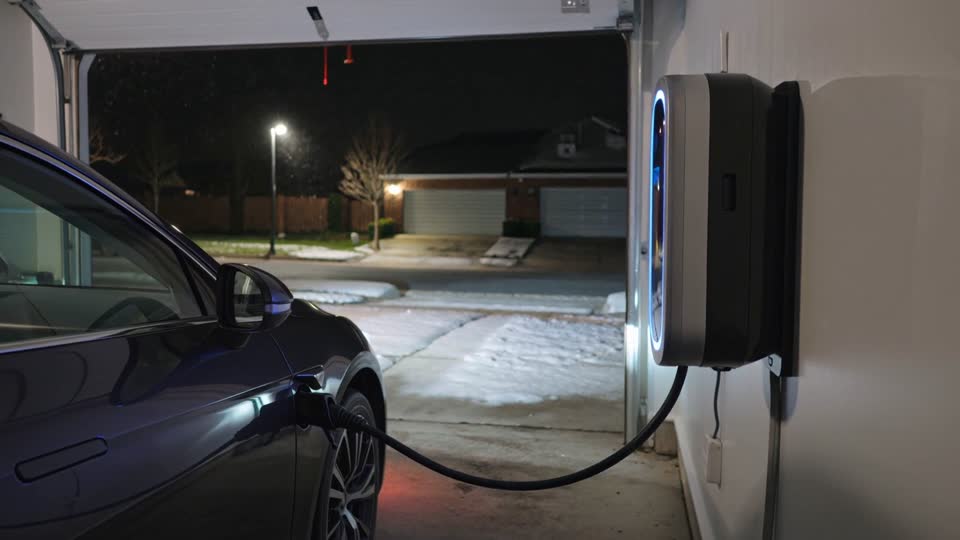
A proper plan starts with measured building demand, not the nameplate on the main breaker. The detail on parkade layouts, billing and fleet-style load sharing is on the commercial and multi-unit EV charging page, and the owner's view is in EV charging at home.
Rebates. The City's ChargeYYC program paid 50% of the upgrades needed to make multi-residential parking EV-ready, up to $6,000 per stall and $90,000 per property.7 It also paid 50% of Level 2 charger purchase and installation, up to $1,000 per single-port station and $2,000 per dual-port station.7 Grants for an EV charging road map covered the lower of $4,000 or 50% of the cost.7 The first intake closed on November 18, 2025, and the City says it anticipates reopening.7 As of September 2026, treat these as caps from a closed program, not money in hand.
CCT 04Rowhouses and townhouses on a gang meter
Some Calgary townhouse complexes share one service entrance, with the meters grouped in a single gang meter base on an end unit or a meter shed. One owner's heat pump, air conditioner or Level 2 charger draws on a service that the whole row depends on.
The City treats this as a shared decision. Electrification work on a rowhouse with a shared gang-meter service needs a Row Housing Electrification Authorization form, signed by the condo board or homeowner association, with the permit application.2
In practice, the contractor needs the board's signature and a load calculation that shows the shared service and the unit's feeder can carry the new load. A board that gets these requests often should commission one capacity review of the whole row. That is cheaper than repeating the question for every owner, and it gives the board a fair rule for who gets the remaining capacity first.
CCT 05Fire alarm, emergency lighting and life safety
Life-safety work carries the heaviest paperwork in a multi-family building. In Calgary, installing or altering a fire alarm needs both an electrical permit and a building permit.2 Where the building's size and occupancy call for professional involvement, the submission needs drawings or letters signed and stamped by an Alberta-registered professional engineer, including a final verification.8
The National Building Code (2023 Alberta Edition) requires fire alarm systems to be verified to CAN/ULC-S537.9 Verification means every device is tested and its result recorded: detectors, pull stations, bells and strobes, supervisory switches, and the annunciator. That includes any device added or moved during a suite renovation. A contractor who relocates a suite's heat detector without arranging re-verification leaves the building with a system that no longer matches its records.
Emergency lighting has its own wiring rules. Receptacles serving emergency lighting unit equipment must be at least 2.5 m above the floor where practicable and within 1.5 m of the unit (CE Code Rule 46-304).10 That keeps battery units from being unplugged for a vacuum cleaner.
Fire alarm work is growing in Calgary. The City's inspection data shows 446 contractor fire alarm permits issued in 2025, against 204 in 2019.11 Where the building code calls for emergency power to these systems, the generator and transfer side is covered on standby power and generators, and suite-level alarms are covered in smoke and CO alarms.
CCT 06Permits, and who may do the work
The most common misunderstanding among condo owners is the homeowner permit. Homeowner permits are not available for apartment-style condominiums in Calgary, so all electrical work in those suites needs a licensed contractor.12 Even replacing a light fixture, which needs no permit,12 can touch common property or the fire alarm, so check the bylaws and ask the property manager first.
Other rules shape larger projects:
- Mixed-use buildings. Base-building work and each commercial tenant space need separate electrical permits.2 Retail at grade is scoped like any tenant improvement.
- Fees. A contractor permit is $112 plus $9.79 per $1,000 of construction value, with the Safety Codes Council fee on top.13 On a building-wide retrofit, construction value includes labour and material, so the fee scales with the job. The detail is on electrical permit fees in Calgary.
- Who signs. Only a master electrician can obtain an electrical permit for a contractor in Alberta.14
Buildings in Airdrie, Cochrane, Chestermere, Okotoks and Rocky View County fall under those municipalities' own permit authorities, not the City of Calgary. For the full process, see electrical permits in Calgary.
Safety
Electrical work in Alberta needs a permit, and most of it must be done by a certified electrician working for a contractor. Homeowner permits have strict limits and do not apply in apartment-style condos at all. Meter rooms, bus duct and switchboards in a multi-family building stay energized even when one suite's breaker is off. Never open or work on energized equipment. Leave it to a qualified electrician with a planned shutdown.
CCT 07Working in an occupied building
Most multi-family electrical work happens around residents who cannot simply move out. Calgary's stock makes this common. The 2021 Census counted 81,870 occupied dwellings in apartment buildings under five storeys15 and 40,700 in buildings of five or more storeys.15 Many of those buildings now need new switchgear, meter stacks or riser work while people live in them.
A good contractor plans the shutdown before pricing the job:
- Utility coordination. ENMAX does not charge for a customer-requested temporary de-energization.16 Re-energization is $166.00 per hour,16 and work the customer needs outside 7:00 a.m. to 4:00 p.m. on weekdays is $352.00 per hour.17 Night shutdowns cost more on the utility side, but they avoid a day without elevators.
- Notice and temporary power. Residents need written notice. Elevators, fire pumps, sump pumps and medical equipment may need a temporary supply or a generator for the outage window.
- Common storage. Charging e-bikes and scooters in lockers and bike rooms is a real risk. Lithium-ion battery fires caused an estimated $32 million or more in property losses in Calgary in 2025.18 Boards adding outlets to bike rooms should decide the charging policy first.
CCT 08What drives the price
No public body publishes prices for multi-family electrical work in Calgary, and no one range covers both a low-rise walk-up and a downtown tower. A contractor prices these drivers:
- Available capacity. Measured demand against the service and riser ratings, and whether a service upgrade or EVEMS is needed.
- Distance and routing. Metres of feeder from the electrical room to the parkade or floor, and whether new cable can use existing sleeves, tray or shafts.
- Engineering. Stamped drawings for services of 600 A and up, fire alarm design and verification, and any capacity study.
- Utility work. ENMAX's share of a service change is estimated case by case.
- Shutdowns and access. Off-hours work, occupied suites, parkade ceiling heights and firestopping at every floor penetration.
- Permits and inspections. Permits are priced on construction value, and more than one permit may apply.
Boards and managers get the most useful quotes when they supply the single-line diagram, recent utility demand data and a clear scope. When that is ready, request a quote and a person reads it and replies.
Questions people ask
How much does it cost to install an EV charger in a condo?
There is no official Calgary figure. The cost depends on where the charger is fed from (the suite panel, a new EV panel or a load-managed system), the distance from the electrical room to the stall, and whether the building needs more capacity. The City's ChargeYYC rebates were capped at $6,000 per stall for EV-ready upgrades, but the intake closed on November 18, 2025.7
Can I do my own electrical work in my Calgary condo?
Not in an apartment-style condo. The City does not issue homeowner permits for those suites, so a licensed electrical contractor must do the work.12 Townhouse owners may have more options, but gang-metered rows need the board's signed authorization for electrification work.
Do I need a permit to install an EV charger in a condo parkade?
Yes. An EV charger needs an electrical permit in Calgary.2 In a condo, the board's approval is also needed, because the charger connects to common property and changes the building's load calculation.
What are the fire alarm requirements in Alberta for apartment buildings?
The National Building Code (2023 Alberta Edition) decides which buildings need a fire alarm system and requires the system to be verified to CAN/ULC-S537.9 In Calgary, fire alarm work needs a building permit and an electrical permit, and an engineer's stamp where professional involvement is required.
Who owns the meters in a Calgary condo building?
ENMAX owns its revenue meters. The building owns the meter sockets and enclosures that hold them.4 Private submeters belong to whoever installed them, and if they are used to bill suites they must be approved, verified and sealed revenue meters under federal rules.
Sources
- Get the power flowingENMAX Power Corporation · retrieved 2026-09-25
- Electrical permits for contractorsCity of Calgary · retrieved 2026-09-25
- Information on the attribution and use of revenue meters under the Electricity and Gas Inspection ActMeasurement Canada · modified 2020-02-05
- ENMAX Power Corporation Distribution Tariff Customer Terms and ConditionsENMAX Power Corporation · effective 2026-01-01
- STANDATA bulletin 24-ECB-008 Circuit loading and demand factorsAlberta Municipal Affairs · April 2025
- STANDATA interpretation 24-ECI-086 Electric vehicle charging systemsAlberta Municipal Affairs · April 2025
- ChargeYYCThe City of Calgary · Phase 2 intake closed 2025-11-18; page retrieved 2026-09-25
- Complete Building Permit Application Requirement List - Commercial: Fire Alarm (repair/upgrading)City of Calgary · retrieved 2026-09-25
- STANDATA interpretation 23-BCI-011/24-ECI-009/23-FCI-006 Existing fire alarm systemsAlberta Municipal Affairs · March 2025
- STANDATA interpretation 24-ECI-046 Emergency power supply, unit equipment, exit signs, and life safety systemsAlberta Municipal Affairs · April 2025
- Electrical Permits and Inspections (dataset vxgy-id5s)The City of Calgary, Open Government Licence – City of Calgary · queried 2026-09-25
- Homeowner electrical and plumbing permitsCity of Calgary · retrieved 2026-09-25
- 2026 Building & Trade Permit Fee Schedule (R2026-02)City of Calgary · 2026 schedule R2026-02
- About Master ElectriciansSafety Codes Council · retrieved 2026-09-25
- Census Profile, 2021 Census of Population - Calgary, City (CY) [Census subdivision], AlbertaStatistics Canada · 2021 Census (May 11, 2021); profile table released 2023-11-15
- ENMAX Power Corporation Distribution Tariff Terms and Conditions Fee ScheduleENMAX Power Corporation · effective 2026-01-01
- ENMAX Power Corporation Distribution Tariff, Terms and Conditions Fee ScheduleENMAX Power Corporation · Effective January 1, 2026
- Fire Prevention WeekCity of Calgary (Calgary Fire Department) · retrieved 2026-09-25
Related
-
 E-201
Tenant improvements
Office, retail and restaurant fit-outs: the drawings, permits, lighting, power and data an electrical contractor prices.
E-201
Tenant improvements
Office, retail and restaurant fit-outs: the drawings, permits, lighting, power and data an electrical contractor prices.
-
 E-202
LED lighting retrofits
Replacing fluorescent, metal halide and HID lighting with LED and controls in warehouses, offices and parking structures.
E-202
LED lighting retrofits
Replacing fluorescent, metal halide and HID lighting with LED and controls in warehouses, offices and parking structures.
-
 E-203
Power distribution & switchgear
Services, switchgear, transformers and distribution for commercial buildings: capacity, coordination and shutdown planning.
E-203
Power distribution & switchgear
Services, switchgear, transformers and distribution for commercial buildings: capacity, coordination and shutdown planning.