Commercial · Drawing E-204
Industrial electrical work in Calgary
Plants, shops and warehouses run on motors, controls and distribution that stay energized for years. This is how that work is permitted, kept safe and priced in Calgary.
CCT 01What counts as industrial electrical work
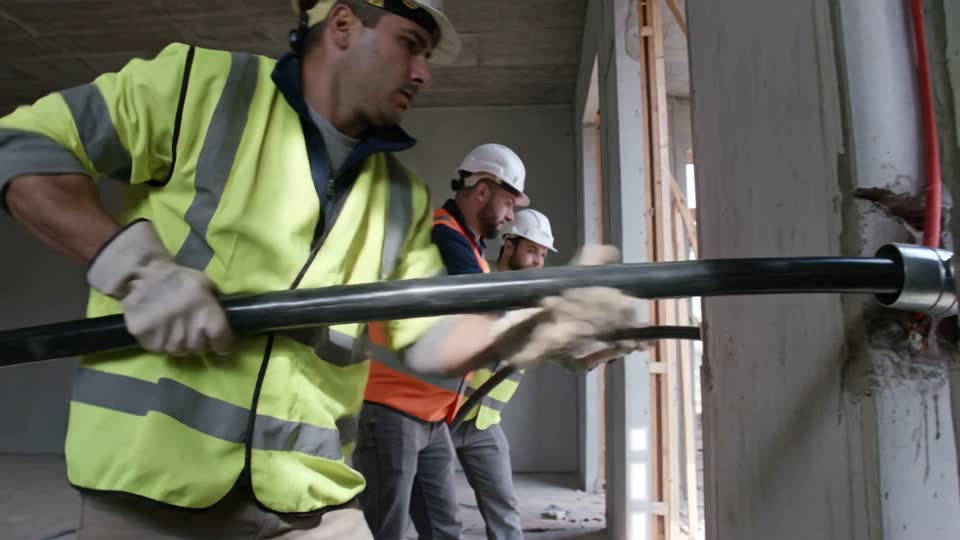
Industrial work is defined less by the building than by the load. It covers motor feeders and starters, variable frequency drives, motor control centres, control panels and PLC wiring, instrumentation, cable tray runs, welding receptacles, crane and hoist power, dust collection and compressed-air systems, and equipment in hazardous locations. The same building usually also needs high-bay lighting (see LED lighting retrofits) and a service large enough for all of it (see power distribution and switchgear).
In Alberta, electrician is a compulsory-certification trade 1. Restricted work can only be done by a certified journeyperson, a registered apprentice under a journeyperson's supervision, or the holder of a recognized certificate 2. The provincial trade title is Electrician, which corresponds to the Red Seal Construction Electrician, NOC 72200 3.
Job Bank tracks industrial electricians as a separate occupation, NOC 72201. About 1,530 people work in it in the Calgary region 4, and Job Bank rates the 2025 to 2027 outlook as Moderate after a labour shortage from 2023 to 2025 4. When hiring for plant work, ask about experience directly. The certificate shows a person is qualified to do electrical work; the work history shows whether they have commissioned drives, traced control faults or worked in classified areas. The hiring guide covers what to check.
CCT 02The annual electrical permit for facilities
A plant that changes something every week cannot pull a permit for every motor swap and new receptacle. The City of Calgary's answer is the Annual Electrical Permit, for facilities that employ a full-time journeyman electrician or have a contractor doing maintenance work. In 2026 it costs $156 plus a $6.24 Safety Codes Council fee, $162.24 in total 5. The code still applies to every job done under it; the annual permit changes how the work is permitted and inspected, not the standard it is built to.
Annual permits are a small, specialized slice of Calgary's permit load. In the City's open data, contractors took out 232 annual electrical permits in 2025, against 478 in 2019. Across 2023 to 2025 there were 687, and 549 of them were at addresses the assessment roll classes as non-residential 6. The count roughly halved between 2022 and 2023, and the data does not say why, so do not read it as fewer facilities maintaining their systems.
Whether a larger project, such as a new production line or a service change, fits under the annual permit or needs its own trade permit is a question for the City before work starts. A standalone contractor permit costs $112 plus $9.79 per $1,000 of construction value 5, and starting work before a permit is issued doubles the fee, a 2x penalty 5. The permits guide explains the process.
CCT 03Arc flash, lockout and CSA Z462:24
Industrial electricians work around energized equipment more than most trades. The Canadian standard for workplace electrical safety is CSA Z462, now in its 2024 edition, CSA Z462:24 7. It covers the employer's electrical safety program, the risk assessment done before any task near exposed energized parts, shock and arc-flash boundaries, how to establish an electrically safe work condition (isolate, lock out, test for absence of voltage), and the protective equipment used when energized work is justified.
For a facility, the practical output is an arc flash study. It models the distribution system from the utility transformer down, runs short-circuit and coordination analysis, calculates incident energy at each panel and MCC, and produces equipment labels. A study is only as good as the single-line drawing behind it, so it needs updating whenever a transformer, main breaker or protective setting changes. Maintenance and thermography covers studies, infrared scans and planned shutdowns in more depth.
We found no part of Alberta's OHS Code that adopts CSA Z462 by name. The Code does govern hazardous-energy control and work near overhead lines, and it places the duty to assess and control hazards on the employer. CSA Z462:24 is the Canadian standard written to do that for electrical equipment.
Safety
Electrical work in Alberta needs a permit, and it must be done by a certified electrician or a registered apprentice under supervision. The homeowner permit covers only an owner-occupied single-family home, never a plant or shop. Never work on or test energized equipment unless you are qualified, the task has been assessed and the right protection is in place; the default is to isolate, lock out and prove it dead.
CCT 04Yards, cranes and overhead lines
Industrial sites move tall equipment: cranes, boom trucks, forklifts with raised masts, scissor lifts and loaded trailers. Alberta's OHS Code Part 17 applies before work is done or equipment operates within 7 m of an overhead power line. The employer must determine the line's voltage and set the safe limit of approach from Schedule 4 8, which sets 1.0 m for bare, uninsulated lines of 0 to 750 V 9 and 3.0 m for lines from 750 V to 40 kV 9. Map every overhead line on the site, including lines to outbuildings, and post the voltage and limit where equipment works.
Underground work has its own rules. Before trenching for a new feeder or a yard light base, request locates through Utility Safety Partners at least 3 to 5 full working days ahead 10. Customer-owned lines, such as a feed between buildings on the same property, are not registered and have to be found with a private locator 11. Industrial sites often have decades of undocumented customer-owned cable. Click before you dig walks through the process.
CCT 05Motors, drives, controls and hazardous locations
Most of the cost and risk in industrial electrical work sits in a handful of design decisions:
- Motor starting. Across-the-line starters are simple but draw a large inrush that can dip voltage for everything else on the bus. Soft starters and drives reduce inrush; drives also add harmonics and heat that the distribution design has to handle.
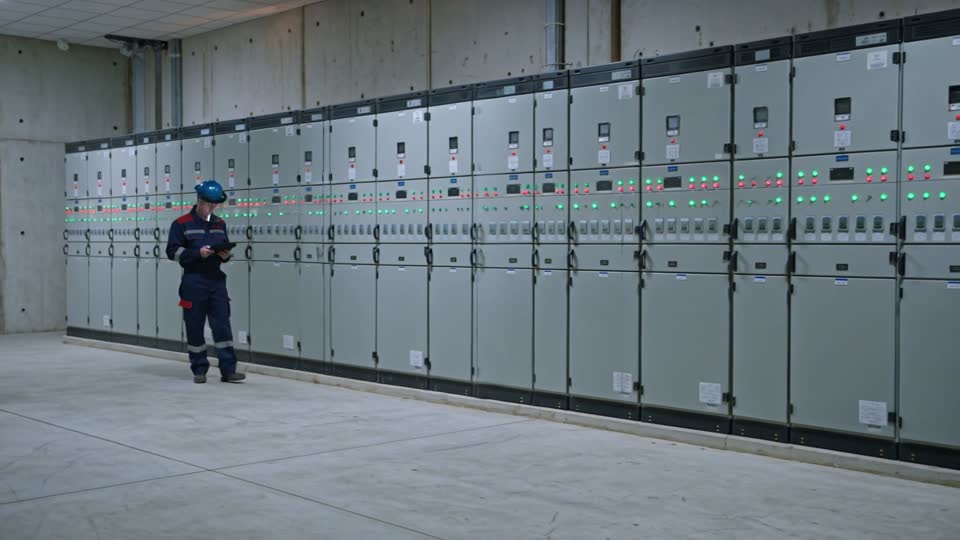
- Motor control centres or individual starters. An MCC gathers starters, overloads and disconnects in one lineup. That simplifies maintenance and lockout, but concentrates fault energy in one place.
- Cable tray or conduit. Tray with armoured cable is quicker to change as a process evolves; conduit gives more mechanical protection. On long runs to a yard or a far wall, voltage drop can force a larger conductor; the voltage drop calculator shows the effect.
- Hazardous locations. Where flammable gas, vapour or combustible dust may be present, the area is classified and the equipment must be rated for that classification. Classification is an engineering decision made before anything is bought; the wrong enclosure cannot be fixed at inspection.
- Controls. PLC panels, safety relays and interlocks need their own drawings and a commissioning test that proves every stop and interlock works.
Calgary's climate is a design input. The Alberta Building Code's January design temperatures for Calgary are −30 °C at 2.5% and −32 °C at 1% 12. Outdoor motors, drive enclosures, heat trace, door heaters and truck plug-ins must start and run at those temperatures, and an unheated building can take controls below their rated range.
CCT 06When a new line or machine outgrows the service
A new compressor, oven or production line can push a building past what its service and ENMAX's transformer were sized for. Start with a year of demand readings from the utility bills and a load study, not the main breaker size. If the service must grow, ENMAX prices the change with a formula: removal cost less salvage, plus installation, less its investment in new load, plus prepaid maintenance on optional facilities and other costs 13.
For medium and large commercial customers, ENMAX's 2026 investment can be taken per kVA of minimum contract demand: $367 on a 15-year agreement, $245 on 10 years or $122 on 5 years, capped at 80% of anticipated maximum demand 14. Services over 200 A need ENMAX CT metering 15, and the City requires plans for services of 600 A and above 16. ENMAX does not confirm capacity when a development permit is circulated 16, so a plant expansion should ask ENMAX about capacity directly and early.
CCT 07What a preventive maintenance program includes
Industrial electrical failures are rarely sudden. Loose terminations heat up, contacts wear, dust builds up in MCC buckets, and protective settings drift away from the study. A preventive maintenance program catches those before they trip a line. A sound one usually includes:
- An up-to-date single-line drawing and equipment list, with the arc flash labels that match it.
- Infrared scans of switchgear, MCCs and panels under load, with repairs scheduled from the findings.
- Planned shutdowns for cleaning, torque checks, insulation testing and breaker testing that cannot be done live.
- Records of every change made under the annual permit, so the next study starts from the truth.
- A spares list for the drives, starters and breakers whose failure would stop production.
Frequency depends on the environment and how critical the load is; a dusty, hot or wet plant needs more attention than a clean warehouse. Schedule shutdown work for the season and shift when the plant can spare it.
CCT 08What drives industrial electrical cost in Calgary
No public body publishes industrial electrical prices or contractor billing rates for Calgary. The official numbers describe inputs:
- Construction costs. Statistics Canada's electrical-division price index for Calgary non-residential buildings was 111.3 in the second quarter of 2026, meaning costs 11.3% above the 2023 average 17. It rose 1.0% in a year 17, slower than the 1.8% across the 15-city composite 17, while Calgary's all-trades non-residential index rose 3.9% 17. It is an index of contractors' costs, not a price.
- Wages. Job Bank reports a median wage of $44.00 an hour for industrial electricians in the Calgary region, with a low of $34.00 and a high of $62.00 18. That is what workers are paid, not what a contractor bills; a billed rate also carries supervision, vehicles, tools, insurance, overhead and margin. See electrician rates in Calgary.
For a specific job, the drivers are the number and size of motors and drives, hazardous-location equipment, cable lengths and tray routes, controls and programming, shutdown windows and overtime, engineering and studies, equipment lead times, and the permit route. Ask for a breakdown that separates material, labour, engineering and shutdown premiums. Commercial electrical cost covers how larger scopes are tendered.
Questions people ask
What is the difference between a commercial and an industrial electrician?
Alberta's compulsory-certification trade is titled Electrician, the Red Seal Construction Electrician, NOC 72200 3. For a facility, the difference that matters is the work: industrial electricians spend their careers on motors, drives, controls and process equipment, so ask about that experience and check the certificate. Job Bank counts them as a separate occupation, NOC 72201, with about 1,530 in the Calgary region 4.
Is an arc flash study required in Alberta?
We found no Alberta OHS Code provision that names CSA Z462. The Code does require employers to assess and control hazards, and CSA Z462:24 7 is the Canadian standard for doing that on electrical equipment. A study is the usual way a facility shows it knows the incident energy at each piece of gear.
What is an annual electrical permit in Calgary?
A yearly City permit for facilities with a full-time journeyman electrician or contractor maintenance work, so routine changes do not each need their own permit. It costs $162.24 in 2026, including the Safety Codes Council fee 5. Confirm with the City which project work it covers.
How much do industrial electricians make in Calgary?
Job Bank reports a median of $44.00 an hour for industrial electricians (NOC 72201) in the Calgary region, from a low of $34.00 to a high of $62.00, for 2023 to 2024 18. Those are wages, not the rates contractors bill.
How much does an arc flash study cost?
No official price exists. The cost follows the size of the system: the number of switchboards, MCCs, panels and transformers to model, whether a current single-line drawing exists or has to be built by tracing the system, how much data collection needs equipment opened, and whether labels and a coordination review are included.
Sources
- Electrician (trade profile)Government of Alberta (Tradesecrets) · retrieved 2026-09-25
- Compulsory Certification TradesGovernment of Alberta (Tradesecrets) · retrieved 2026-09-25
- Construction ElectricianRed Seal Program (Government of Canada / CCDA) · retrieved 2026-09-25
- Industrial Electrician in the Calgary Region | Job prospects - Job BankEmployment and Social Development Canada (Job Bank) · Outlook 2025-2027, updated 2025-12-10; recent trends updated 2026-07-28; page modified 2026-08-07
- 2026 Building & Trade Permit Fee Schedule (R2026-02)The City of Calgary · 2026 fee schedule, revision R2026-02; retrieved 2026-09-25
- Electrical Permits and Inspections (dataset vxgy-id5s)The City of Calgary, Open Government Licence – City of Calgary · queried 2026-09-25
- CSA Z462:24 Workplace Electrical Safety - Online TrainingCSA Group · retrieved 2026-09-25
- Occupational Health and Safety Code, Part 17 Overhead Power LinesGovernment of Alberta · retrieved 2026-09-25
- Occupational Health and Safety Code, Schedule 4 Safe Limit of Approach DistancesGovernment of Alberta · retrieved 2026-09-25
- Notification ProcessUtility Safety Partners · retrieved 2026-09-25
- Homeowner OverviewUtility Safety Partners · retrieved 2026-09-25
- National Building Code - 2023 Alberta Edition, Volume 1, Division B, Appendix C, Table C-2 Climatic Design Data for Selected Locations in AlbertaAlberta Municipal Affairs / National Research Council of Canada · 2023 Alberta Edition, second printing incl. revisions and errata released April 2026
- ENMAX Power Corporation Distribution Tariff, Customer Terms and ConditionsENMAX Power Corporation · Effective January 1, 2026
- ENMAX Power Corporation Distribution Tariff, Terms and Conditions Investment Level ScheduleENMAX Power Corporation · Effective January 1, 2026 (applies January 1 to December 31, 2026)
- Get the power flowingENMAX Power Corporation · retrieved 2026-09-25
- Electrical permits for contractorsCity of Calgary · retrieved 2026-09-25
- Table 18-10-0289-01 Building construction price indexes, by type of building and divisionStatistics Canada · Q2 2026 (April-June 2026); released 2026-07-24
- Industrial Electrician in Alberta | Wages - Job Bank (NOC 72201)Employment and Social Development Canada (Job Bank) · Reference period 2023-2024 (Labour Force Survey); wages updated 2025-11-19
Related
-
 E-201
Tenant improvements
Office, retail and restaurant fit-outs: the drawings, permits, lighting, power and data an electrical contractor prices.
E-201
Tenant improvements
Office, retail and restaurant fit-outs: the drawings, permits, lighting, power and data an electrical contractor prices.
-
 E-202
LED lighting retrofits
Replacing fluorescent, metal halide and HID lighting with LED and controls in warehouses, offices and parking structures.
E-202
LED lighting retrofits
Replacing fluorescent, metal halide and HID lighting with LED and controls in warehouses, offices and parking structures.
-
E-203
Power distribution & switchgear
Services, switchgear, transformers and distribution for commercial buildings: capacity, coordination and shutdown planning.