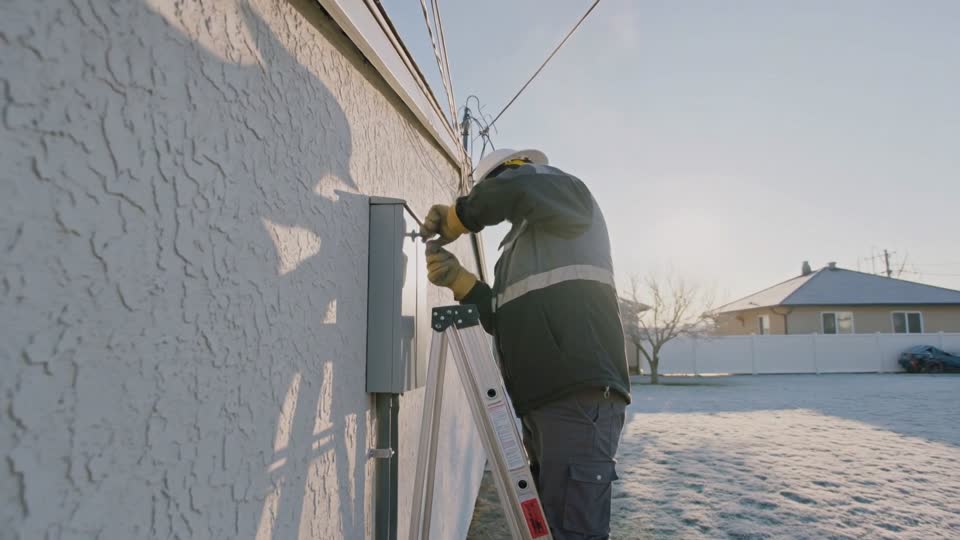
Guide · Drawing E-404
100 A vs 200 A service
Whether 100 A is enough is not a matter of opinion or house size alone. It is a calculation, and the loads you are adding (a charger, a heat pump, a suite) decide the answer.
Plenty of Calgary houses run happily on 100 A. Plenty of others are already close to their limit before anyone adds an EV charger. The difference is the load, and the Canadian Electrical Code has a set method for adding it up. This guide explains the method, the loads that tip the balance, and what an upgrade involves.
CCT 01How to tell what service you have
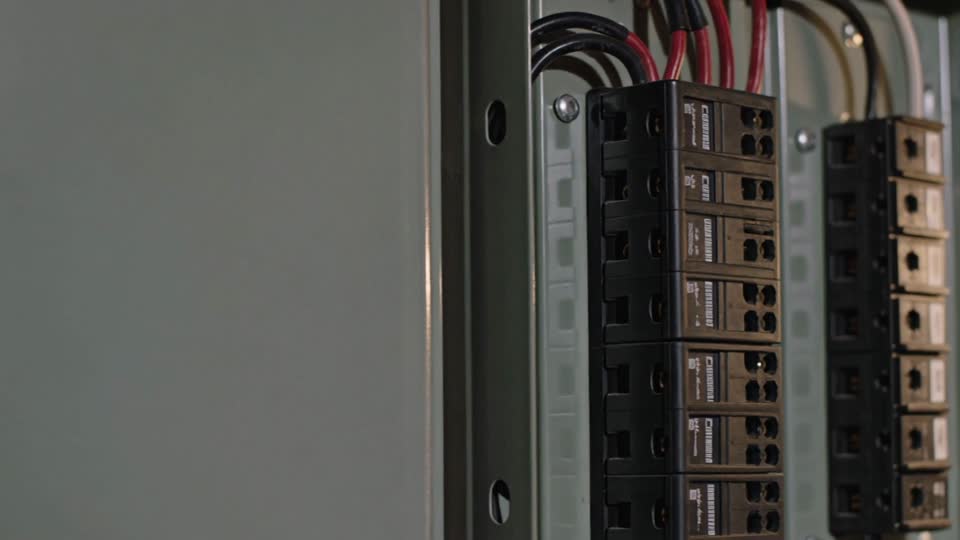
Open the panel door, not the cover. On most breaker panels the main breaker sits at the top, apart from the rows of branch breakers, and its handle is stamped with its rating: 100, 125, 200 and so on. That number is the most useful single clue to your service size. If there is no main breaker at the top, the main may be in a separate disconnect beside the panel or near the meter, or the house may still have a fuse panel.
The main breaker is only one link in a chain. The service conductors from the meter, the meter base, the panel's own bus rating and the main breaker all have ratings, and the service is limited by the smallest of them. A 200 A breaker in a panel fed by smaller conductors is not a 200 A service. Only an electrician can confirm the whole chain.
Calgary's housing stock spans every era. The City's secondary-suite guidance refers to existing services of 60, 100 or 200 A when it tells a contractor to contact ENMAX about increasing one.1 Older inner-city homes are more likely to have a small original service, but age alone does not tell you the size. Look, and if the label is unreadable, ask an electrician.
Safety
Read the main breaker with the panel door open and the inner cover (dead front) in place. Never remove that cover: the service conductors behind it are live even with the main breaker off. Electrical work in Alberta needs a permit, most of it needs a certified electrician, and Calgary homeowner permits exclude the main service, panel and meter base entirely.
CCT 02What a Rule 8-200 load calculation does
Rule 8-200 sets the method for a single dwelling's calculated load. In plain terms, the calculation does four things:
- It starts from a basic load that scales with the home's living area, representing lighting and general-use receptacles.
- It adds electric space heating and air conditioning, each under its own counting rules.
- It adds the range, the water heater and other fixed appliances, with demand factors that reflect the fact that not everything runs at once.
- It compares the result, converted to amperes, with the rating of the service.
Alberta's interpretation adds a detail that decides many real cases: for a single-dwelling service or feeder calculation, each load with a nameplate rating over 1,500 W is counted at its nameplate rating.2 Hot tubs, EV chargers, heat pumps, dryers, ranges and electric water heaters all sit above that line, so each one adds its full nameplate figure before demand factors are applied.
The calculation is what the City and the utility care about. It is not the same as your highest reading on a power monitor, and a meter showing that "the house never pulls more than half the breaker" does not replace it. To run the numbers for your own home, use the home load calculator. It is an estimate that follows the code method; the calculation an electrician submits is the one that counts.
CCT 03EV chargers and load management
An EV charger is usually the load that turns a comfortable 100 A service into a tight one, because it is large and runs for hours. Alberta's interpretation is strict about how it is counted: a charger whose current setting can be changed without an electrician must be taken at its maximum demand in the branch circuit, service or feeder calculation.3 Turning a charger down in its app does not reduce its calculated load.
In apartment-type buildings, when no EV energy management system is used, EV supply equipment is taken at 100% when calculating individual suite feeders under Rule 8-202.2 That wording points at the alternative to a bigger service: an energy management or load management system that limits the charger when the rest of the house is busy. In Calgary that equipment is not homeowner work; EVEMS and load management systems are on the list homeowners may not install.1
So an EV on a 100 A service has three possible answers from a load calculation: it fits as-is, it fits with a managed charger, or the service needs to grow. See EV charger installation and EV charging at home.
CCT 04Heat pumps and a minus-thirty design day
Natural Resources Canada says a 200 A electrical service is normally required for an all-electric air-source or ground-source heat pump.4 That is a rule of thumb from the federal program, not a code requirement; the load calculation still decides. It is also a strong signal. Calgary's January 2.5% design temperature is -30 °C,5 and a heat pump sized for that climate usually brings electric backup heat that runs hardest on exactly the days the rest of the house is also drawing most.
A hybrid setup, where a heat pump works alongside the existing gas furnace, is usually a smaller electrical load than an all-electric system, because the furnace rather than electric backup carries the coldest hours. Operating cost is a separate question. An NRCan study found that in a split gas and electric scenario, adding a cold-climate air-source heat pump raised utility bills by $100 to $500 a year in Alberta, Ontario, Manitoba and colder parts of B.C.6
CCT 05Suites, hot tubs, garages and rowhouses
Other additions that commonly push a service over the line:
- A secondary suite. Calgary asks for a secondary suite electrical load calculation sheet; if the service must be increased, the contractor contacts ENMAX.1 See basement and renovation wiring.
- A hot tub. It needs a building permit and an electrical permit in Calgary,7 GFCI protection,8 and its nameplate load goes straight into the calculation.
- A detached garage or shop. A subpanel feeding a heater, welder or charger is a feeder load on the house service. See hot tubs, garages and subpanels.
- A rowhouse on a shared meter base. Electrification work there needs a Row Housing Electrification Authorization form signed by the condo board or homeowner association.7
Air conditioning belongs on this list too, and its wiring is also excluded from homeowner permits in Calgary.1
CCT 06Above 200 A: separate permits, CT metering and 400 A
200 A is where several Calgary thresholds sit. For new residential single construction, the City requires a separate permit and inspection if the service is greater than 200 A.7 On the utility side, ENMAX services rated over 200 A must submit a current-transformer (CT) request form and a CT meter installation checklist.9 A CT meter measures the service through transformers rather than carrying the full current through the meter itself, so the metering equipment and its layout change.
Much larger services change who supplies what. For residential service connections of 400 A or more in ENMAX territory, the customer must supply their own service cables.10 Those are custom-home and large-shop numbers; for most existing houses the realistic question is 100 A or 200 A, and whether load management can defer the jump.
CCT 07What an upgrade involves
A service upgrade is contractor work from start to finish, because Calgary homeowners may not install, alter or modify the main service, main panel, main breaker or meter base.1 The sequence runs like this: the electrician confirms the load calculation and takes out the permit, then arranges ENMAX's temporary disconnect and reconnect, which needs at least 3 business days' notice.11 The old equipment comes out, the new meter base, mast and panel go in, the work is inspected, and ENMAX reconnects.
ENMAX prices each service change individually. For 2026 it invests $3,168 per residential service toward new load, and the customer contributes the actual cost of the connection above that.10 That figure is a credit toward the utility's side, not the price of an upgrade. What drives the total is the distance to the utility connection, overhead or underground service, the meter base and mast, the panel, how many circuits move, and the permit. The ENMAX service connection guide covers the utility side, and panel and service upgrade cost covers the price drivers.
Questions people ask
Is 100 amp service enough for a house?
It can be, particularly in a gas-heated home without large added loads. The answer comes from a Rule 8-200 load calculation, where every load over 1,500 W counts at its nameplate rating.2 Try the load calculator for an estimate.
Is 100 amp service enough for an EV charger?
Is 100 amp service enough for a heat pump?
NRCan says a 200 A service is normally required for an all-electric air-source or ground-source heat pump.4 A hybrid system that keeps the gas furnace is a smaller load; a load calculation decides.
How do I know what amp service I have?
Check the rating stamped on the main breaker handle with the panel door open, and never remove the inner cover. The service is limited by the smallest rating among the conductors, meter base, panel and main breaker, so ask an electrician to confirm.
Sources
- Homeowner electrical and plumbing permitsCity of Calgary · retrieved 2026-09-25
- STANDATA bulletin 24-ECB-008 Circuit loading and demand factorsAlberta Municipal Affairs · April 2025
- STANDATA interpretation 24-ECI-086 Electric vehicle charging systemsAlberta Municipal Affairs · April 2025
- Heating and cooling with a heat pumpNatural Resources Canada · Page modified 2025-12-24
- National Building Code - 2023 Alberta Edition, Volume 1, Division B, Appendix C, Table C-2 Climatic Design Data for Selected Locations in AlbertaAlberta Municipal Affairs / National Research Council of Canada · 2023 Alberta Edition, second printing incl. revisions and errata released April 2026
- Cold-climate air source heat pumps: Assessing cost-effectiveness, energy savings and greenhouse gas emissions reductions in Canadian homesNatural Resources Canada · Page modified 2025-01-11
- Electrical permits for contractorsCity of Calgary · retrieved 2026-09-25
- STANDATA bulletin 24-ECB-068 Pools, tubs, and spasAlberta Municipal Affairs · April 2025
- Get the power flowingENMAX Power Corporation · retrieved 2026-09-25
- ENMAX Power Corporation Distribution Tariff, Terms and Conditions Investment Level ScheduleENMAX Power Corporation · Effective January 1, 2026 (applies January 1 to December 31, 2026)
- Temporary disconnect / reconnectENMAX Power Corporation · retrieved 2026-09-25
Related
-
E-401
Electrical permits in Calgary
When you need an electrical permit in Calgary, homeowner versus contractor permits, inspections and what happens without one.
-
E-402
Hiring an electrician
Certification, master electricians, permits, insurance, quotes and contracts: what to check before anyone opens your panel.
-
 E-403
The electrical code in Alberta
Which edition of the Canadian Electrical Code applies in Alberta, how Alberta amends it, and where STANDATA bulletins fit.
E-403
The electrical code in Alberta
Which edition of the Canadian Electrical Code applies in Alberta, how Alberta amends it, and where STANDATA bulletins fit.