Guide · Drawing E-406
Electrical emergencies & outages
Most electrical problems can wait for an electrician. A few cannot. Here is how to tell the difference, what to do in the first minutes, and who handles what in Calgary.
This site does not dispatch electricians. When something is live and dangerous, emergency services and the utility come first, and a repair comes later. This page sorts situations into three groups: call 911 now, make it safe and call an electrician, and outages that belong to ENMAX Power.
CCT 01The first minutes: sort the situation
Ask three questions in order.
- Is there fire, smoke you cannot place, or a person hurt? Get everyone out and call 911. Do not go back for anything, and do not try to reach the panel through smoke.
- Is a power line involved, outside or underground? Call 911 (see the next section). Keep everyone, including pets, well back.
- Is it inside the house and not burning? A sparking receptacle, a burning smell from one outlet, a breaker that is hot or buzzing, or water dripping near electrical equipment. Make it safe from a distance if you can, stop using it, and call an electrician.
Some problems feel urgent but are not dangerous on their own: a breaker that trips and resets, a dead circuit with no smell or heat, flickering on one circuit. They still need attention. A breaker that keeps tripping explains what a trip is telling you, and inspections and troubleshooting covers how an electrician finds the fault.
Safety
Never touch a person or object in contact with live equipment, never stand in water near electrical equipment, and never work on anything energized. Electrical repairs in Alberta need a permit, most need a certified electrician, and a homeowner permit never covers the service, panel or meter base. If in doubt, stay back and call 911.
CCT 02Call 911: fire, lines down, contact
ENMAX Power, the utility that owns the lines in Calgary, tells the public to call 911 immediately if a power line is sparking or on fire, is on the ground, or has been dug up or exposed.1 Treat every fallen line as live, even if it is silent and the lights on the street are out. The ground around it can be energized, so keep well back and keep others back until crews arrive.
Call 911 as well when:
- a person or animal is in contact with a line or with anything touching one (a fence, a ladder, a vehicle). Do not touch them;
- a vehicle is in contact with a line. If you are inside it, stay inside and call unless fire forces you out;
- a panel, meter base or appliance is on fire or smoking heavily.
Digging is the other common way people meet a line. If an excavation hits or exposes a buried cable, stop, move everyone away and call 911. The click before you dig guide explains locates, and why lines between buildings on your own lot, such as a garage feed, are not on the utility's records.
CCT 03How close is too close to an overhead line
Alberta's Occupational Health and Safety Code sets hard limits for workers, and they are a useful yardstick for anyone with a ladder, a pole saw or a boom. Before work is done or equipment is operated within 7 m of an overhead power line, the employer must determine the line's voltage and set the safe limit of approach from Schedule 4.2 For bare, uninsulated lines of 0 to 750 V, that limit is 1.0 metre.3 For lines of 750 V to 40 kV, it is 3.0 metres.3
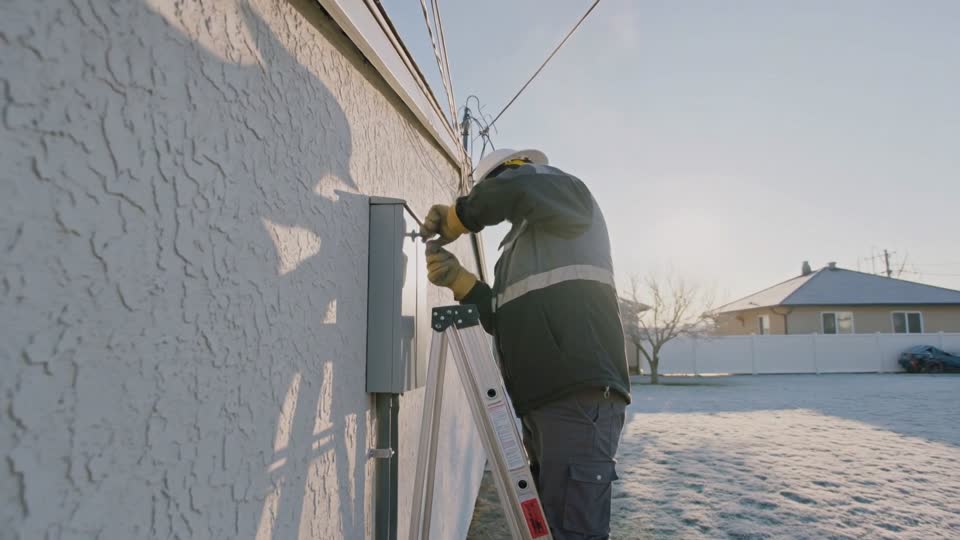
Those distances apply to trained workers who know the voltage. A homeowner usually does not, and the service drop to the house, the lines along the back lane and the distribution lines on the street look similar from the ground. The practical rule: nothing you hold or carry (an aluminum ladder, a tree branch, an eavestrough section, a pool skimmer pole) goes anywhere near an overhead line. Leave tree work near lines to crews qualified for it.
CCT 04Outages belong to ENMAX, not your retailer
Inside Calgary, ENMAX Power owns the distribution system and charges its distribution tariff to every customer, whoever sells them the energy.4 That makes ENMAX the company that handles outages. Your retailer bills you; it does not repair lines. Report an outage and check its status on ENMAX's outage map and reporting page.
Before you report, check it is not just your house. If the neighbours have power, look at your panel: a tripped main breaker or a single dead circuit is a house problem for an electrician, not a utility outage. If only half the house is dead, or lights dim and brighten strangely, that can signal a problem on the service conductors; turn off sensitive equipment and call ENMAX and an electrician.
Calgary outages are a winter problem as much as a nuisance. The city's January 2.5% design temperature is -30 °C,5 and a gas furnace still needs electricity for its blower and controls. Plan for the furnace before the cold snap, not during it: see winter electrical in Calgary.
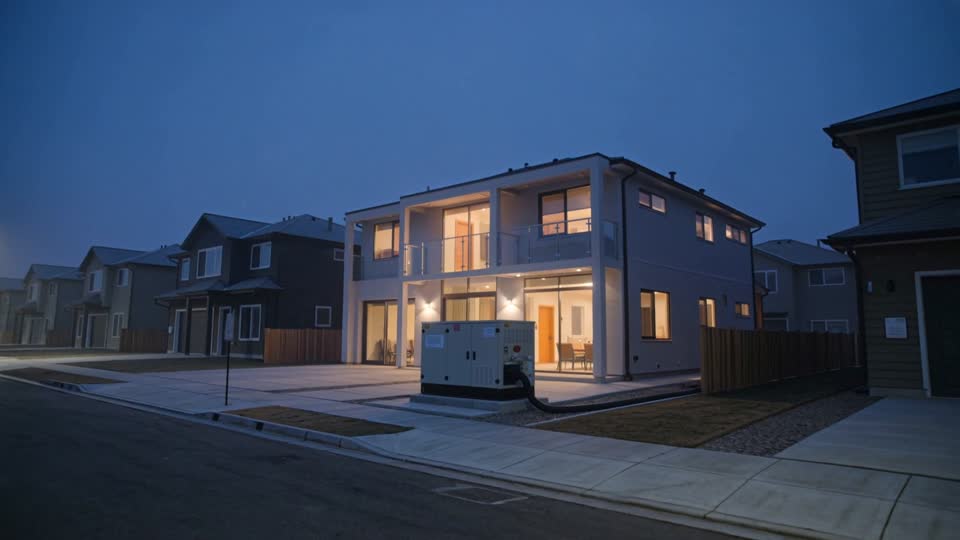
Generators help only if they are connected properly. Never plug a generator into a household receptacle to back-feed the house; it can energize the utility's lines and the people working on them. A permanent connection needs a transfer switch or interlock, a permit and an electrician. Alberta's variance for meter-mounted transfer equipment will be archived on January 1, 2027,6 so check what is accepted before buying one. See generators and backup power.
CCT 05When to shut off the main breaker
Turning off the main breaker is the right move in a few situations, and the wrong one in others.
Shut it off if you can reach the panel standing on a dry floor, the panel itself shows no heat, smoke, scorching or water, and:
- water is coming into the house and heading toward outlets, baseboard heaters or appliances, and you are leaving the area;
- something is arcing or smells of burning and you cannot tell which circuit it is on;
- a fire crew or an electrician asks you to.
Do not approach the panel if you would have to stand in water, if the panel is wet, hot, buzzing or smoking, or if the basement is flooded. Leave and call 911 or ENMAX.
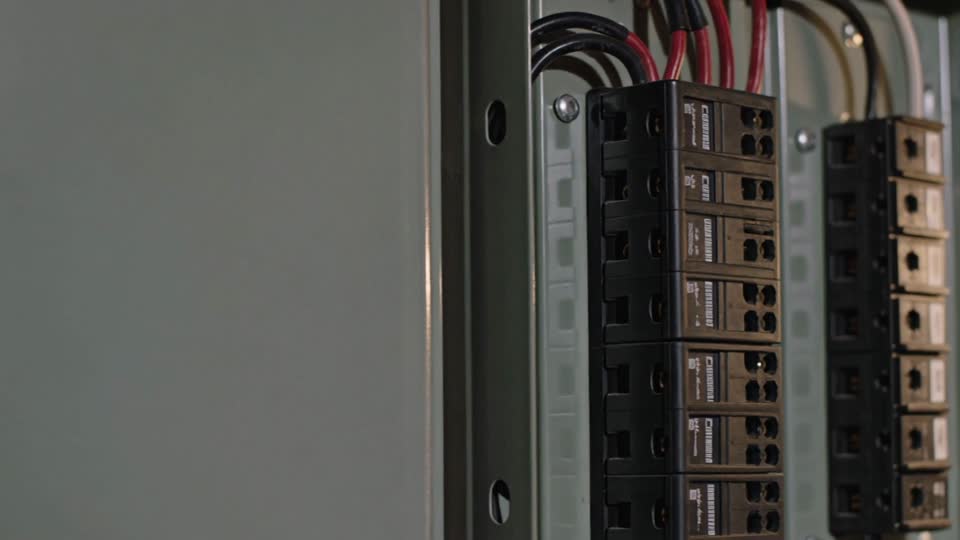
Know what the main does not do. The service conductors, the meter base and the terminals feeding the main breaker stay energized with the main off. Only ENMAX can de-energize the service, and only an electrician should open the panel. After a flood, have an electrician inspect any wiring, panel or appliance that got wet before it is re-energized.
CCT 06Lithium-ion battery fires
Batteries are now one of the city's significant fire causes. The City of Calgary reports estimated fire-related property losses of over $32 million from lithium-ion battery fires in 2025 alone.7 The batteries are in e-bikes, e-scooters, power tools, laptops and portable power stations, and the fires tend to start during charging.
The habits that reduce the risk are simple. Charge with the charger made for the device. Charge where you can see it, on a hard surface, and not in the path you would use to get out of the house. Unplug when charging is done. Stop using a battery that is swollen, damaged, hot to the touch or smells odd, and take it to a proper recycling drop-off rather than the garbage.
A lithium-ion fire is not one to fight. It can reignite and gives off toxic smoke. Get out, close the door behind you if you can, and call 911. For a home battery system, as opposed to a device battery, the installation itself is regulated: Calgary homeowners may not install battery storage under a homeowner permit.8
CCT 07Smoke alarms: the first warning
The Calgary Fire Department advises at least one smoke alarm on every level of the home, including the basement, and one inside every bedroom or outside every sleeping area.9 It also advises testing them monthly and replacing them after 10 years.9 The date of manufacture is printed on the back of the alarm; if you cannot find one, it is almost certainly past that age.
In new work, the National Building Code (Alberta Edition) sets alarm locations and requires multiple alarms in a residence to be interconnected, so one sounding sets off the rest.10 Hard-wired residential alarms normally need a 120 V connection from a 15 A circuit.10 A basement development or major renovation is the usual moment to bring alarms up to that standard. See smoke and CO alarms.
CCT 08After the emergency: getting it repaired
Once the danger is over, the repair follows the normal rules. Damaged wiring, a scorched panel or a flooded service needs an electrician, a permit and an inspection. If ENMAX disconnected the service, it may need an electrical permit number and a completed inspection, or an authorization from the City's Electrical Inspections department, before it reconnects.11 The ENMAX service connection guide covers that sequence.
Take photos before anything is removed, tell your insurer early, and keep the electrician's invoice and permit number with the claim. When you are ready to get a repair priced, request a quote with photos and a description; a person reads every request and replies. Hiring an electrician explains how to check whoever does the work.
Questions people ask
Who do I call for a power outage in Calgary?
ENMAX Power, the company that owns the distribution lines in Calgary, handles outages;4 use its online outage map and reporting page. Your retailer does not repair outages. If only your house is out, check your main breaker first.
What do I do if a power line is down?
Call 911 immediately. ENMAX says to call 911 if a line is sparking or on fire, on the ground, or dug up or exposed.1 Treat it as live and keep everyone well back.
What should I do if I smell burning from an outlet?
Stop using it, and if you can reach the panel safely on a dry floor, switch off that circuit or the main breaker. If there is smoke or flame, get out and call 911. Either way, have an electrician inspect it before it is used again.
Is it safe to go near the panel if my basement is flooded?
No. Do not enter standing water near electrical equipment. Leave, and call 911 or ENMAX to have the service de-energized. An electrician should inspect anything that got wet before power is restored.
How often should smoke alarms be replaced?
The Calgary Fire Department advises replacing smoke alarms after ten years and testing them monthly.9
Sources
- Outages and safetyENMAX · accessed 2026-09-25
- Occupational Health and Safety Code, Part 17 Overhead Power LinesGovernment of Alberta · retrieved 2026-09-25
- Occupational Health and Safety Code, Schedule 4 Safe Limit of Approach DistancesGovernment of Alberta · retrieved 2026-09-25
- Tariffs and feesENMAX Power Corporation · retrieved 2026-09-25
- National Building Code - 2023 Alberta Edition, Volume 1, Division B, Appendix C, Table C-2 Climatic Design Data for Selected Locations in AlbertaAlberta Municipal Affairs / National Research Council of Canada · 2023 Alberta Edition, second printing incl. revisions and errata released April 2026
- Notice to archive 24-ECV-002-024-MMTE: Meter mounted transfer equipmentAlberta Municipal Affairs · July 2026
- Fire Prevention WeekCity of Calgary (Calgary Fire Department) · retrieved 2026-09-25
- Homeowner electrical and plumbing permitsCity of Calgary · retrieved 2026-09-25
- Smoke alarmsCity of Calgary (Calgary Fire Department) · retrieved 2026-09-25
- STANDATA bulletin 24-ECB-032 Fire alarm systems, smoke alarms, carbon monoxide alarms, and fire pumpsAlberta Municipal Affairs · April 2025
- Temporary disconnect / reconnectENMAX Power Corporation · retrieved 2026-09-25
Related
-
 E-401
Electrical permits in Calgary
When you need an electrical permit in Calgary, homeowner versus contractor permits, inspections and what happens without one.
E-401
Electrical permits in Calgary
When you need an electrical permit in Calgary, homeowner versus contractor permits, inspections and what happens without one.
-
E-402
Hiring an electrician
Certification, master electricians, permits, insurance, quotes and contracts: what to check before anyone opens your panel.
-
 E-403
The electrical code in Alberta
Which edition of the Canadian Electrical Code applies in Alberta, how Alberta amends it, and where STANDATA bulletins fit.
E-403
The electrical code in Alberta
Which edition of the Canadian Electrical Code applies in Alberta, how Alberta amends it, and where STANDATA bulletins fit.