
Commercial · Drawing E-208
Data centres and critical power in Calgary
What keeps a server room or data hall running when the grid does not, how redundancy is really specified, and what Calgary’s utility and grid mean for a new critical load.
Critical power is a chain, and a chain fails at its weakest link. A data hall can have two utility feeds and four generators and still go dark because both power supplies in a server plugged into the same strip. This page walks the chain from the ENMAX service to the rack, in the order an electrical engineer and contractor design, build and prove it.
CCT 01The critical power chain, from utility to rack
Every data centre, from a small comms room to a colocation hall, uses the same links:
- Utility service. ENMAX Power supplies the building. Large sites may take one or more medium-voltage feeds.
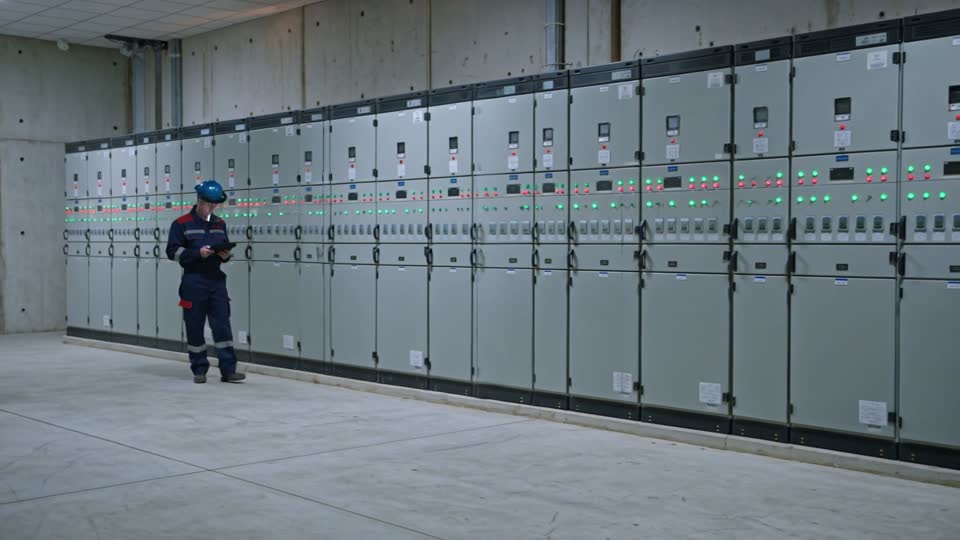
- Main switchgear. This is where the utility and generators meet, through automatic transfer switches or paralleling switchgear (see power distribution and switchgear).
- Generators. These carry the load through a long outage.
- UPS (uninterruptible power supply). Batteries or flywheels bridge the seconds between a utility failure and generator pickup, and clean up the power in normal operation.
- Distribution. Power distribution units (PDUs), remote power panels or overhead busway carry power to the rows.
- Rack PDUs. These are the final strips that the servers' dual power supplies plug into.
Cooling belongs in the chain too. Servers survive a transfer on UPS power, but chillers, CRAH units and pumps usually restart only once the generator picks up. If those units restart slowly, room temperature can end the outage for you. Critical mechanical loads are part of the electrical design.
CCT 02Redundancy, explained without marketing numbers
Redundancy is described with a simple notation. N is the capacity the load needs. Everything else is spare. This page quotes no uptime percentages: availability depends on design, maintenance and operations, and a figure attached to a design level is a claim, not a measurement.
| Configuration | What it means | What it protects against |
|---|---|---|
| N | Just enough UPS, generator or cooling capacity for the load | A utility outage only, with nothing spare if a unit fails |
| N+1 | One more unit than the load needs, on a shared path | The failure or maintenance of any single unit |
| 2N | Two complete, independent systems (A and B), each able to carry the full load | The loss of an entire path, including its switchgear and distribution |
| 2N+1 | Two independent systems, each with a spare unit | The loss of a path while a unit on the other path is also down |
Two plain questions sort real redundancy from a drawing label:
- Is it concurrently maintainable? Can any single component be shut down for maintenance without dropping the load? N+1 UPS modules on one output bus still share that bus.
- Is it fault tolerant? Will the load survive an unplanned failure anywhere in the path? That usually needs separate A and B paths all the way to dual-corded servers, and a static transfer switch for any single-corded equipment.
CCT 03UPS, batteries and busway
Most critical sites use double-conversion UPS systems. Incoming power is converted to DC and back to AC, so the load always runs from the inverter and a utility disturbance never reaches it. Each UPS needs a maintenance bypass, so that it can be serviced while the load stays on raw or generator power. The bypass arrangement needs as much design attention as the UPS itself.
Batteries are the part that fails quietly. Valve-regulated lead-acid strings need regular testing and a planned replacement. Lithium-ion cabinets are smaller and lighter but bring their own fire-protection and ventilation requirements, which the fire and building reviewers will ask about. Battery rooms also carry a DC arc-flash hazard that many AC-focused safety programs miss.
Downstream, overhead busway has largely replaced under-floor cable whips in new halls. Plug-in tap boxes let a rack be added or moved without a shutdown, and metering in each tap box shows per-rack load. The trade-off is up-front cost and careful planning of the A and B busway runs, so that one fault or drop cannot take out both.
Long feeders from a UPS room to remote rows need a voltage-drop check. The voltage drop calculator gives a first estimate before the engineer's design.
CCT 04Generators and transfer in a Calgary winter
Calgary's January 2.5% design temperature is −30 °C, and the 1% value is −32 °C.1 A generator that starts reliably on a test day in June has to do the same in January. Alberta's all-time peak demand of 12,785 MW was set in winter, on December 11, 2025.2
For a critical site that means:
- engine block heaters and battery chargers on circuits that are themselves monitored
- winter-grade fuel, with fuel polishing or turnover for diesel stored on site
- enclosures and louvres designed for drifting snow, so that intake and exhaust stay clear
- transfer switches or paralleling gear with a bypass, so that the transfer equipment can be maintained without an outage
Transfer schemes, emergency versus standby loads and load-bank testing are covered on standby power and generators.
CCT 05Getting capacity in Calgary: ENMAX and the AESO
Capacity is now the first question for any new critical load in Alberta, and the answer depends on size.
Server rooms and colocation suites. These are served by ENMAX Power under its distribution tariff. ENMAX does not confirm electrical capacity when it reviews a circulated development permit, so confirm capacity with ENMAX early, especially on inner-city sites.3 ENMAX invests in new load and the customer pays the rest of the connection cost. For 2026, the investment is $14,675 per meter for small commercial (D200) load.4 Medium and large customers (D300/D310) may instead take $367 per kVA of minimum contract demand on a 15-year agreement, $245 on 10 years or $122 on 5 years, up to 80% of anticipated maximum demand.4 These are ENMAX's investment credits, not the price of a connection. They also show that a longer demand commitment buys more utility investment.
Hyperscale campuses. The Alberta Electric System Operator (AESO) handles large transmission-connected loads. In June 2025 it set an interim limit of 1,200 MW of additional large load, applying to projects of 75 MW or more, after 29 proposed projects totalling more than 16 GW sought connection.5 The AESO says all 1,200 MW was allocated, and that other large-load requests move to Phase 2 of its program.6 For scale, the 1,200 MW limit is close to the Calgary region's record average load of 1,239 MW in 2025.2
For a new building service, see commercial new construction and the ENMAX service connection guide.
CCT 06Safety: CSA Z462 and energized equipment
Data centres create pressure to work on equipment live, because the business case for the room is that it never goes off. CSA Z462:24 is the current edition of Canada's workplace electrical safety standard.7 It sets out the risk assessment, the arc-flash and shock boundaries, and the justification required before anyone works on energized equipment.
A well-run critical site removes most reasons to work live:
- maintenance bypasses and A/B paths, so that equipment can be isolated and locked out while the load stays up
- a current arc-flash study, with labels on every switchboard, UPS, PDU and panel
- infrared windows or permanent monitoring, so that scans do not need covers off
- written switching procedures, rehearsed before the maintenance window
Safety
Electrical work in Alberta needs a permit, and critical-power work must be done by certified electricians working for a contractor. Homeowner permits do not cover it. A UPS output, a battery string and a generator can each keep a circuit live after the utility breaker is open. Never work on energized equipment. Isolate, lock out and test for absence of voltage under a written procedure.
The maintenance program itself is described on maintenance and thermography.
CCT 07Commissioning: proving the design works
Redundancy that has never been tested is an assumption. Commissioning turns it into evidence, in stages:
- Factory witness testing of UPS modules, switchgear and generators before they ship.
- Delivery and installation checks: damage, torque, labelling and conductor terminations.
- Start-up of each system by the manufacturer's technician.
- Functional tests of each system on its own: UPS on load bank, generator transfer, bypass operation.
- Integrated systems testing. The whole site is run together at design load, usually with load banks in the white space, and the utility supply is pulled to prove that UPS, generators, cooling and controls respond as designed.
The integrated test is the one owners are tempted to skip, and it is the one that finds the fault: a control wire that misses a breaker, or a CRAH that does not restart. Ask for the test scripts and results as part of the turnover documents. The City's electrical inspection confirms code compliance. It does not test redundancy.
CCT 08Permits and what drives the price
A Calgary server room or data hall needs an electrical permit pulled by a master electrician's contractor. Services of 600 A or more need plans and drawings.3 A colocation tenant's fit-out is permitted separately from base-building work.3 That is the same split as any tenant improvement. Fire alarm, suppression interfaces and any emergency power required by the building code bring their own reviews.
No public body publishes a cost per kilowatt or per rack for data centre electrical work in Calgary, and design choices swing the total more than any unit price does. A contractor prices:
- the redundancy level, since 2N roughly doubles the major equipment against N
- UPS technology and battery runtime
- generator count, fuel storage and enclosures
- busway versus cable distribution
- ENMAX's customer contribution for the service
- commissioning scope, including load-bank rental
- whether the work happens in a live facility
For context, Statistics Canada's electrical-trade construction price index for Calgary non-residential buildings stood at 111.3 in Q2 2026 (2023=100).8 See commercial electrical cost for how that index should and should not be used. When the load, redundancy target and site are known, request a quote and a person replies.
Questions people ask
What is N+1 redundancy in a data centre?
N is the capacity the load needs. N+1 adds one spare unit, such as one extra UPS module or generator, so that any single unit can fail or be serviced without dropping the load. It does not protect against a failure in shared switchgear or distribution. That takes separate A and B paths (2N).
How much power can a new data centre get in Alberta?
Does a server room electrical project need an engineer in Calgary?
The City requires plans and drawings for services of 600 A and above and for all high-voltage installations.3 Below that, engineering is still usually wise for UPS, generator and redundancy design, and fire alarm work needs a stamp where professional involvement is required.
What does a data centre electrical contractor do?
The contractor installs and terminates the switchgear, UPS, generator connections, busway and branch circuits to the engineer's design. It also pulls the permits, coordinates with ENMAX, and supports start-up and integrated testing. Ask any bidder for critical-site references and for its energized-work and switching procedures under CSA Z462.
Which electrical safety standard applies in a Calgary data centre?
The Canadian Electrical Code governs the installation. For work on or near energized equipment, CSA Z462:24 is the current edition of the workplace electrical safety standard,7 and employers use it to build their arc-flash and safe-work programs.
Sources
- National Building Code - 2023 Alberta Edition, Volume 1, Division B, Appendix C, Table C-2 Climatic Design Data for Selected Locations in AlbertaAlberta Municipal Affairs / National Research Council of Canada · 2023 Alberta Edition, second printing incl. revisions and errata released April 2026
- AESO 2025 Annual Market Statistics (March 2026)Alberta Electric System Operator (AESO) · Calendar 2025; winter peak through Feb 2026; published March 2026
- Electrical permits for contractorsCity of Calgary · retrieved 2026-09-25
- ENMAX Power Corporation Distribution Tariff, Terms and Conditions Investment Level ScheduleENMAX Power Corporation · Effective January 1, 2026 (applies January 1 to December 31, 2026)
- AESO Announces Interim Approach to Large Load ConnectionsAlberta Electric System Operator · June 4, 2025
- Large Load ProjectsAlberta Electric System Operator · retrieved 2026-09-25
- CSA Z462:24 Workplace Electrical Safety - Online TrainingCSA Group · retrieved 2026-09-25
- Table 18-10-0289-01 Building construction price indexes, by type of building and divisionStatistics Canada · Q2 2026 (April-June 2026); released 2026-07-24
Related
-
 E-201
Tenant improvements
Office, retail and restaurant fit-outs: the drawings, permits, lighting, power and data an electrical contractor prices.
E-201
Tenant improvements
Office, retail and restaurant fit-outs: the drawings, permits, lighting, power and data an electrical contractor prices.
-
 E-202
LED lighting retrofits
Replacing fluorescent, metal halide and HID lighting with LED and controls in warehouses, offices and parking structures.
E-202
LED lighting retrofits
Replacing fluorescent, metal halide and HID lighting with LED and controls in warehouses, offices and parking structures.
-
E-203
Power distribution & switchgear
Services, switchgear, transformers and distribution for commercial buildings: capacity, coordination and shutdown planning.