Residential · Drawing E-107
Solar PV and batteries in Calgary: the electrical side
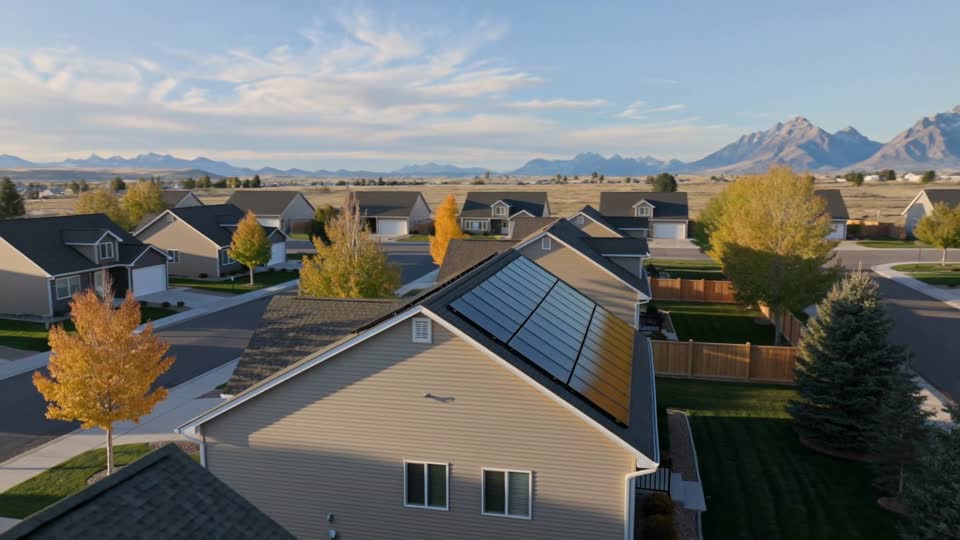
A solar array is a small power plant connected to your panel and to ENMAX’s grid. This page explains the rules, the connection and the paperwork, not which panels to buy.
Solar sales pages focus on panels and payback. The electrical questions decide whether the system is allowed to switch on: whether your service can take it, what the inverter must be certified to, what ENMAX needs to know, and what the City inspector checks.
CCT 01What the electrical scope includes
A grid-tied rooftop system has four electrical parts, and each one is inspected:
- DC wiring from the modules to the inverter or optimizers. Under the 2024 Canadian Electrical Code, PV systems with a dc circuit voltage of 80 V or more need dc arc-fault protection (Rule 64-216).1
- The inverter, which turns dc into ac and controls how the system behaves on the grid. Since January 1, 2025, every new inverter connecting to ENMAX Power’s system needs UL 1741 SB Category II certification.2
- The ac connection into your panel or service, with a disconnect and labelling.
- The meter. A small micro-generator gets a bi-directional cumulative meter that records energy in both directions.3
In Calgary, photovoltaic collectors need an electrical permit and must be installed by a licensed and registered electrical contractor.4 Solar PV and battery storage are both excluded from homeowner permits.5 Many solar companies hold that permit themselves or subcontract the electrical scope; either way, ask who the master electrician on the permit is.
CCT 02Alberta’s micro-generation rules in brief
Alberta’s Micro-Generation Regulation lets a home or business generate its own renewable electricity and send the surplus to the grid. The Alberta Utilities Commission’s current Rule 024, Rules Respecting Micro-Generation, took effect on April 1, 2026.6
- Size classes. Small micro-generation is under 150 kW of total nameplate capacity.3 Large micro-generation is at least 150 kW and not more than 5 MW.3 Almost every house is in the small class.
- Size cap. A unit may not exceed the lesser of 5 MW or the rating of your service, and it must be intended to meet all or part of the site’s own annual consumption.3
- ENMAX sizing. ENMAX uses 12 months of the site’s consumption history to set the target production, and annual production should not exceed consumption.2
- Notice. You give the wire owner, ENMAX Power in Calgary, notice on the AUC form, and the owner has 14 days to file a dispute with the Commission.3
- Credits. A small micro-generator is credited for exported energy at the same rate its retailer charges for energy, unless both agree in writing to something else.3 Retailers pay out unused credits once a year, and self-generation does not reduce delivery charges such as distribution and transmission.7
The micro-generation guide covers the regulation in more depth.
CCT 03From design to switch-on
- Consumption and site review. Twelve months of bills, roof orientation and shading, and a look at the panel and service.
- Design. Array size matched to consumption, inverter selection, and how the ac output connects to the panel.
- Micro-generation notice to ENMAX. Filed on the AUC form before the system is connected.
- City electrical permit. Pulled by the electrical contractor. Roof-mounted systems can raise building questions too, which the installer should confirm with the City.
- Installation. Racking and modules, dc wiring, inverter, disconnects and the ac connection.
- Final inspection. A final electrical inspection by the municipal inspector is required before a micro-generation unit operates.8
- Meter and retailer. The bi-directional meter goes in and the retailer starts crediting exports.
No official source publishes how long this takes in Calgary, and it varies with ENMAX’s and the City’s queues. How the service side works is covered in ENMAX service connections.
CCT 04Panel and service capacity
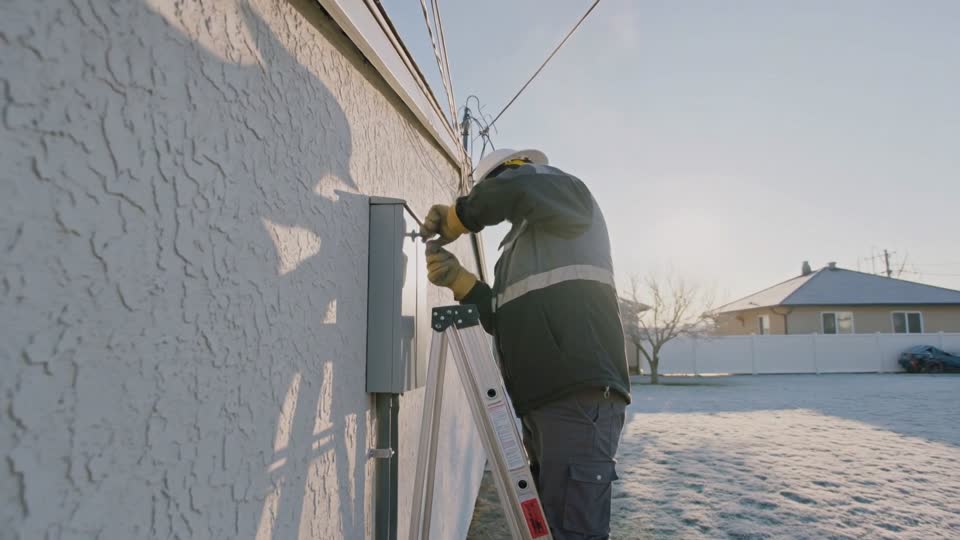
Solar interacts with your panel in two ways. First, the system cannot exceed the lesser of 5 MW or your service rating,3 so an older small service can limit the array. Second, the inverter’s output has to land somewhere: on a breaker in the panel, where the busbar and main breaker ratings limit how much can be added, or on the supply side of the main breaker, which is a larger job and involves the service equipment.
If you are also planning an EV charger, a heat pump or a battery, look at all of them together before the solar design is fixed. The home load calculator estimates your calculated load. If the answer is a larger service, a panel and service upgrade may belong in the same project, and 100 A vs 200 A service explains the trade-off.
CCT 05Calgary solar by the numbers
The City issued 3,750 solar PV permits in 2025,9 down from the peak of 4,905 in 2024.9 In 2019 it issued 565.9 From 2023 to 2025, 62.8% of Calgary’s PV permits were for existing buildings rather than new construction; in 2025 alone that was 2,689 of 3,750.9 Solar also dominates one inspection stage: 18,671 of the 20,313 permits in the City’s data with a “Service” inspection are PV permits.9
Utility data tell a similar story from a different angle. AESO’s data record 17,783 solar micro-generation sites commissioned in the ENMAX wire-owner zone from 2009 to May 2026, not net of any removals.10 In 2025, 4,021 sites were commissioned there, against 5,252 in 2024.10 Across Alberta there were 49,311 solar micro-generation sites at the end of August 2026.11
These are separate measures and should not be added together: a permit is not a site, and the ENMAX zone does not match city limits exactly. Batteries remain rare in the one dataset that tracks them: among homes that completed the City’s clean-energy financing program, 60 had solar PV in 2025 and none had battery storage.12 More is on the Calgary electrical data page.
CCT 06Designing for a Calgary winter
Cold changes the electrical design. A solar module’s voltage rises as it gets colder, so the designer sizes each string against the coldest temperature the site is expected to see, making sure the inverter’s maximum input voltage is never exceeded on a clear, frigid morning. Calgary’s January 1% design temperature is −32 °C,13 and a design that works on a mild spring day can be over the limit then.
Snow is the other factor. The building code’s 1-in-50-year ground snow load for Calgary is 1.1 kPa,13 and the roof has to carry the array as well as the snow that collects around it. That is a structural question for the installer and, where needed, an engineer, not the electrician. Snow also slides off glass modules faster than off shingles, so keep conduit, the disconnect and the meter out of the path of falling snow, and keep it clear of doors and walkways.
Production is low in December and high in June. Because unused credits are settled once a year,7 a system sized to annual consumption will export in summer and import in winter, and that is how it is meant to work.
CCT 07Adding a battery
A battery does one or both of two jobs: storing solar output for use later in the day, and backing up selected circuits in an outage. Backup needs more than the battery. The system must isolate the house from ENMAX’s lines during an outage, and the circuits it will carry are usually moved to a backup subpanel. A grid-tied solar system without that arrangement shuts down when the grid does, even in full sun.
Battery storage needs a contractor permit in Calgary.5 In a rowhouse on a shared gang meter base, the City requires a Row Housing Electrification Authorization form signed by the condo board or homeowner association with the permit application.14 Location matters too: follow the manufacturer’s instructions on clearances and temperature, which can matter in an unheated Calgary garage in January. For comparing a battery with a generator, see generators and backup power.
Safety
Solar modules produce dc voltage whenever light reaches them, and turning off the inverter or the main breaker does not make the array wiring dead. Batteries hold energy even when everything else is switched off. Electrical work in Alberta needs a permit, and solar and battery work in Calgary must be done by a contractor, not under a homeowner permit. Never open an inverter, combiner or battery enclosure, or work on energized equipment.
CCT 08Costs, credits and financing
No current official source publishes an installed cost for residential solar in Calgary. The City’s own Residential Solar Calculator is configured with an assumption of $2.45 per watt and 400 W panels15. That is a calculator default, not a market price or a quote. The federal regulator’s 2018 study used $3.197 per watt for a 5 kW home system,16 which is history, not a current benchmark. What moves the electrical share of the price is the panel and service work, the distance from array to inverter to panel, batteries, and the permit.
On the savings side, exported energy is credited at your retailer’s energy rate, and delivery charges are not reduced. ENMAX’s Rate of Last Resort, for example, is 12.06 ¢/kWh through 2026, an energy charge only.17
The City’s Residential Clean Energy Improvement Program is closed to new applications until winter 2026/2027.18 When open, it finances up to 100% of eligible costs to a maximum of $50,000, repaid through the property tax bill,18 at a rate the City estimates at 6.00%–6.10%,18 over up to 20 years.18 Projects must total at least $3,000.19 See the solar installation cost guide for the evidence in full.
Questions people ask
Do you need a permit for solar panels in Calgary?
Is solar worth it in Calgary?
It depends on your consumption, roof, financing and energy rate, and there is no official current installed cost to plug in. Exports are credited at your retailer’s energy rate, but delivery charges are not offset.7 The City’s solar calculator is a reasonable first pass, as long as you remember its $2.45 per watt is an assumption.15
How does micro-generation work in Alberta?
Are there solar rebates in Calgary right now?
The City’s Residential CEIP financing is closed until winter 2026/2027.18 It is financing repaid on the tax bill, not a rebate. Check program pages for the current status before you sign a contract that depends on them.
Will my solar panels work during a power outage?
Not on their own. A grid-tied system shuts down when the grid goes down. Running through an outage needs a battery or backup-capable inverter, a way to isolate the house from the grid, and usually a backup subpanel, all under a contractor permit.5
Sources
- STANDATA variance 24-ECV-064-216 Arc-fault protection for ground-mounted solar PVAlberta Municipal Affairs · April 2025
- Connect a micro-generatorENMAX Power Corporation · retrieved 2026-09-25
- Micro-Generation Regulation, Alta Reg 27/2008 (office consolidation)Alberta King's Printer · consolidation current as of 2024-09-27
- Residential solar collectorsCity of Calgary · retrieved 2026-09-25
- Homeowner electrical and plumbing permitsCity of Calgary · retrieved 2026-09-25
- Rule 024: Rules Respecting Micro-GenerationAlberta Utilities Commission · retrieved 2026-09-25
- Micro-generationUtilities Consumer Advocate (Government of Alberta) · retrieved 2026-09-25
- Micro-generation notice submission guideline (2026)Alberta Utilities Commission · issued February 2026
- Electrical Permits and Inspections (Open Calgary dataset vxgy-id5s)City of Calgary · Issued-date year; dataset refreshed daily, queried 2026-09-25
- Wind and Solar Microgen Capacity by Wire Owner (datafile Wind-and-Solar-Microgen-by-Wire-Owner-by-Year.xlsx)Alberta Electric System Operator (AESO) · Data through 2026-05-31; datafile updated 2026-06-24
- Small Distribution-Connected Generation Resources in Alberta (Micro- and Small Distributed Generation Report, September 2026)Alberta Electric System Operator (AESO) · Data as of 2026-08-31; report dated September 2026
- Residential Clean Energy Improvement Program Results (dataset 2jxp-s4bx)The City of Calgary, Open Government Licence – City of Calgary · queried 2026-09-25
- National Building Code - 2023 Alberta Edition, Volume 1, Division B, Appendix C, Table C-2 Climatic Design Data for Selected Locations in AlbertaAlberta Municipal Affairs / National Research Council of Canada · 2023 Alberta Edition, second printing incl. revisions and errata released April 2026
- Electrical permits for contractorsCity of Calgary · retrieved 2026-09-25
- Residential solar calculatorThe City of Calgary · Page configuration retrieved 2026-09-25
- ARCHIVED - Economics of Solar Power in Canada - MethodsCanada Energy Regulator · Report released 2018 (market snapshot 2018-12-06); archived page dated 2022-06-30
- Utilities Consumer Advocate: Default ratesGovernment of Alberta (Utilities Consumer Advocate) · Fixed 2025-01-01 to 2026-12-31; page read 2026-09-25
- Residential Clean Energy Improvement Program (CEIP)City of Calgary · Page read 2026-09-25
- The City of Calgary CEIP Residential Terms and ConditionsAlberta Municipalities / The City of Calgary · Terms last updated March 3, 2026
Related
-
E-101
Panel & service upgrades
Replacing an old panel or raising a 60 or 100 A service to 200 A: what it involves, who does which part, and what drives the price.
-
 E-102
EV charger installation
Level 2 charging at home: circuit sizing, whether your panel can carry it, load management, permits and winter charging.
E-102
EV charger installation
Level 2 charging at home: circuit sizing, whether your panel can carry it, load management, permits and winter charging.
-
 E-103
Basement & renovation wiring
Wiring a basement development, secondary suite, kitchen or addition: rough-in, inspections and the circuits the code expects.
E-103
Basement & renovation wiring
Wiring a basement development, secondary suite, kitchen or addition: rough-in, inspections and the circuits the code expects.