Residential · Drawing E-111
Heat pump, A/C and electric heat circuits in Calgary
A heat pump is sold by the HVAC trade, but whether your house can run one is an electrical question. Here is how the circuit, the disconnect and the service are worked out, and who permits which part.
Most Calgary houses were built around a gas furnace, a gas water heater and often a gas range. Electrification moves those loads onto the electrical service one at a time: a heat pump in place of the A/C, an induction range in place of the gas cooktop, baseboard or in-floor heat in a basement. Each is a large load on its own circuit. Together they are what decides whether a 100 A service is still enough.
CCT 01Which appliances this covers
This page covers the large, fixed electrical loads that come with heating, cooling and cooking:
- Cold-climate air-source heat pumps. An outdoor unit, an indoor air handler or furnace coil, and usually electric backup heat. Ducted and ductless (mini-split) systems have the same electrical logic.
- Central air conditioning. An outdoor condensing unit on its own 240 V circuit, working with the existing furnace fan.
- Induction and electric ranges. A 240 V range circuit and receptacle, or a hardwired cooktop and wall oven on separate circuits.
- Electric baseboard and in-floor heat. Heaters or heating cable on 240 V circuits, controlled by line-voltage or low-voltage thermostats.
The electrical work is the same sequence each time: read the nameplate, check the service, run a dedicated circuit, provide a disconnect where the equipment needs one, and get it inspected. NRCan says a 200 A service is normally required for an all-electric air-source or ground-source heat pump.1 That is guidance, not a rule. A load calculation on your actual house is what decides it.
CCT 02Reading the nameplate: MCA and maximum overcurrent
A heat pump or A/C outdoor unit does not come with a simple amp rating. Its nameplate lists two numbers that the electrician works from:
- Minimum circuit ampacity (MCA). The smallest current the circuit conductors must be able to carry. It already allows for the compressor and fan motors running together, so the electrician does not add anything to it.
- Maximum overcurrent protection (MOCP), sometimes shown as maximum fuse or breaker size. The largest breaker or fuse the manufacturer allows. Compressors draw a large current for an instant on start-up, so this can be higher than the MCA.
The conductor is chosen so its ampacity is at least the MCA, for the conductor material, insulation temperature rating and installation method. The breaker is chosen no larger than the MOCP. The code tables that turn those choices into a wire size belong to the electrician; they are not reproduced here, and a chart on a website cannot replace the nameplate and the installation manual. Two heat pumps with the same tonnage can have different MCA values.
Indoor equipment is read the same way. An air handler with electric backup heat lists its own MCA and MOCP, often per heater section. An induction range lists its rating in kW, and the manual states the circuit it needs. Baseboard heaters and heating cable are listed in watts. For the load calculation, each load over 1,500 W is counted at its nameplate rating.2
CCT 03Dedicated circuits and the disconnect within sight
Every piece of this equipment gets its own circuit from the panel. A heat pump system usually needs at least two: one for the outdoor unit, and one or more for the indoor air handler and its backup heat. Converting a gas range to induction means a new 240 V circuit where there was only a 120 V receptacle for the igniter and clock.
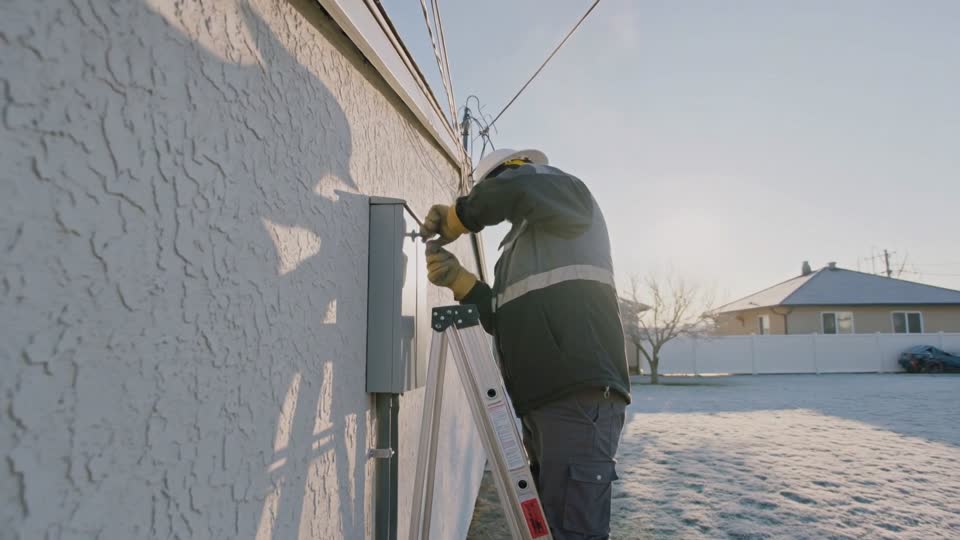
Outdoor units also need a disconnecting means within sight of the unit, so a service technician can lock the power off where they are working, instead of trusting a breaker in a basement they cannot see. In practice it is a weatherproof switch or pull-out disconnect on the wall beside the unit, with a short flexible connection to the equipment. The electrician places it where it is reachable, clear of the refrigerant lines and not behind the unit. Indoor equipment may use the furnace-style service switch or a disconnect built into the air handler, as the manufacturer and code allow.
Two details come up at inspection. The disconnect and the cable route to it must suit an outdoor location, including snow sliding off a roof onto a side-yard unit. And line-voltage thermostats for baseboard heaters switch 240 V directly, so replacing one is circuit work, not a battery swap.
In-floor heating cable is inspected before it disappears under tile. The cable manufacturer's instructions set the tests to run before and after the floor goes down and the protection it needs, so keep them with the permit paperwork.
CCT 04100 A or 200 A: the load calculation decides
"Is 100 amp service enough for a heat pump?" is the question most Calgary owners ask, and the honest answer is that it depends on what else the house draws. The code's calculated-load method for a single dwelling, Rule 8-200, adds up a base allowance for floor area and then the large loads. Each load over 1,500 W goes in at its nameplate rating.2 The method also has provisions for loads that cannot run at the same time, which matters when a heat pump replaces an air conditioner rather than adding to one.
Three houses show why no rule of thumb works:
- A 100 A house with gas heat, gas range and gas dryer that swaps its A/C for a heat pump and keeps the furnace as backup. The added load may be small.
- The same house with an electric range, an electric dryer and an EV charger. The heat pump may be the load that tips it over.
- An all-electric conversion with backup heat strips. This is the case NRCan describes as normally needing 200 A.1
Run your own numbers in the home load calculator, and read 100 A vs 200 A service for how the decision is made. If the answer is an upgrade, the job becomes a panel and service upgrade with ENMAX involved. Services over 200 A need ENMAX's current-transformer (CT) metering request.3
CCT 05Backup heat strips are the big load
A cold-climate heat pump keeps heating well below freezing, but its output falls as the outdoor temperature drops, just as the house needs more heat. Calgary's January design temperature is −30 °C, and the 1% design temperature is −32 °C.4 Something has to make up the difference on those nights.
In an all-electric system that is resistance heat: electric strips in the air handler. They are often the largest single load in the house, larger than the heat pump itself, and they run exactly when every other heater and block heater on the street is running too. The design choices that control them are electrical choices:
- How many kW of strips. Sized by the heat-loss calculation, not by the largest kit the air handler accepts.
- Staging and lockouts. Controls that bring strips on in steps, and only below a set outdoor temperature.
- Dual fuel. Keeping the gas furnace as the backup. The heat pump handles most of the season, the furnace takes the coldest hours, and there are no strips to feed. This is often what lets a heat pump fit a 100 A service.
Operating cost is a separate question. One NRCan study found that in a split gas and electric scenario, adding a cold-climate heat pump raised utility bills by $100 to $500 a year in Alberta and other cold provinces.5 That is one national study's scenario, not a forecast for your house. The running cost calculator works from your own price per kWh.
CCT 06Rowhouses, condos and energy management systems
Attached homes often share an electrical service, and the City has specific rules for them. In a rowhouse, installing a Level 2 EV charger, electric heat pump, A/C unit, hot tub or battery storage needs an electrical load calculation by a professional electrician or engineer, and the condo board or homeowners association must be aware of the added load.6
The reason is the gang meter base. One service runs from the ENMAX transformer to a shared meter base, which splits it to each home, and each home gets only the capacity calculated when the complex was designed.7 Where rowhouses share a gang meter base, the permit application must include a Row Housing Electrification Authorization form signed by the condo board or homeowner association.7 In apartment-style condos, homeowner permits are not available at all.6
If the calculation shows the home cannot carry the new load, the City names two options: upgrade the electrical service, with the electrician contacting ENMAX, or install an energy management system (EMS) that shares the available capacity among the appliances.7 An EMS can hold the heat pump, range and EV charger inside the service rating by delaying or reducing one while another runs. The City accepts models certified to ULC-ORD-3141 or on its interim accepted list without a separate load calculation; an unlisted model needs the load calculation submitted to electrical inspections with the permit number.7
CCT 07Permits: the HVAC contractor’s and the electrician’s
A heat pump or A/C job usually carries two trades and two permits. All heating, ventilating and air conditioning installations in new buildings and renovations need a mechanical permit, and homeowners may not do work that involves natural gas.8 The City's electrification table lists central air conditioning as needing electrical and mechanical permits, and electric heat as needing an electrical permit.7
The electrical permit can only be pulled by a contractor with a master electrician; master electricians are the only contractors who can obtain electrical permits in Alberta.9 Some HVAC companies have an electrical contractor in-house and some subcontract the circuit. Ask each quote which company holds which permit, and whether the load calculation is included.
Homeowner permits do not cover air-conditioning wiring, EV charging, EMS or load management, solar or batteries.6 A heat pump is also the house's air conditioner, so plan on a contractor for it and confirm with the City before assuming otherwise. The City also says load calculations must be done by a qualified electrician.6 An electric range or baseboard circuit in a home you live in may fall within a homeowner permit; the homeowner permit guide explains the limits. Starting before the permit is issued doubles the fee.10 Airdrie, Cochrane, Chestermere, Okotoks and Rocky View County issue their own permits; see permits around Calgary.
Safety and the law
Electrical work in Alberta needs a permit, and most of it must be done by a certified electrician. Homeowner permits are limited to a home you live in and exclude air-conditioning wiring and all main service work. Outdoor units hold capacitors that can stay charged after the power is off. Never open equipment or work on anything energized.
Questions people ask
What size breaker do I need for a heat pump?
The one the nameplate allows, and no larger than its maximum overcurrent protection (MOCP). The conductor is sized from the minimum circuit ampacity (MCA). Two units of the same tonnage can differ, so the electrician reads the actual nameplate and installation manual before choosing either.
Do you need 200 amp service for a heat pump?
Does a heat pump need a disconnect?
Yes. The outdoor unit needs a disconnecting means within sight of it, usually a weatherproof switch or pull-out disconnect on the wall beside the unit, so a technician can lock off power where they are working.
What are the electrical requirements for an induction stove?
A dedicated 240 V circuit sized to the range’s nameplate and manual, ending in a range receptacle or a hardwired connection. Switching from gas means a new circuit from the panel, and the range counts in the load calculation at its nameplate rating.
Is there a heat pump rebate in Alberta?
As of September 2026, none was found open for a typical gas-heated Calgary home. The federal Greener Homes Loan is closed,11 and the City’s residential Clean Energy Improvement Program is closed until winter 2026/2027.12 The heat pump electrical cost guide lists each program’s status.
Can I wire my own air conditioner or heat pump in Calgary?
No. Calgary homeowner permits exclude air-conditioning wiring,6 and the HVAC side needs a mechanical permit.${CITY_MECH}
Sources
- Heating and cooling with a heat pumpNatural Resources Canada · Page modified 2025-12-24
- STANDATA bulletin 24-ECB-008 Circuit loading and demand factorsAlberta Municipal Affairs · April 2025
- Get the power flowingENMAX Power Corporation · retrieved 2026-09-25
- National Building Code - 2023 Alberta Edition, Volume 1, Division B, Appendix C, Table C-2 Climatic Design Data for Selected Locations in AlbertaAlberta Municipal Affairs / National Research Council of Canada · 2023 Alberta Edition, second printing incl. revisions and errata released April 2026
- Cold-climate air source heat pumps: Assessing cost-effectiveness, energy savings and greenhouse gas emissions reductions in Canadian homesNatural Resources Canada · Page modified 2025-01-11
- Trades permits for homeownersThe City of Calgary · read 2026-09-27
- Electrical permits: electrification, EMS and rowhouse servicesThe City of Calgary · read 2026-09-27
- Mechanical permitsThe City of Calgary · read 2026-09-27
- About Master ElectriciansSafety Codes Council · retrieved 2026-09-25
- 2026 Building & Trade Permit Fee Schedule (R2026-02)The City of Calgary · 2026 fee schedule, revision R2026-02; retrieved 2026-09-25
- Closed: Canada Greener Homes LoanNatural Resources Canada · Page modified 2026-04-17; read 2026-09-25
- Residential Clean Energy Improvement Program (CEIP)The City of Calgary · Page retrieved 2026-09-25
Related
-
E-101
Panel & service upgrades
Replacing an old panel or raising a 60 or 100 A service to 200 A: what it involves, who does which part, and what drives the price.
-
 E-102
EV charger installation
Level 2 charging at home: circuit sizing, whether your panel can carry it, load management, permits and winter charging.
E-102
EV charger installation
Level 2 charging at home: circuit sizing, whether your panel can carry it, load management, permits and winter charging.
-
 E-103
Basement & renovation wiring
Wiring a basement development, secondary suite, kitchen or addition: rough-in, inspections and the circuits the code expects.
E-103
Basement & renovation wiring
Wiring a basement development, secondary suite, kitchen or addition: rough-in, inspections and the circuits the code expects.